Get Full Government Meeting Transcripts, Videos, & Alerts Forever!
Get email alerts on the Urban Forestry topic
No spam. Unsubscribe anytime.
Residents, nonprofits press DDOT to expand community-led tree care and pass two tree-protection bills
Summary
Nonprofits and neighborhood groups told the Council Committee on Transportation and the Environment they want a DDOT pilot to let community groups help maintain street trees and urged rapid passage of two local tree bills: the Tree Preservation Enhancement Amendment Act and the Office of Natural Area Conservation Establishment Act.
Members of a citywide panel on urban forestry told the Council's Committee on Transportation and the Environment that existing city planting efforts need follow-through and local partners to keep young trees alive and to protect older trees in natural areas.
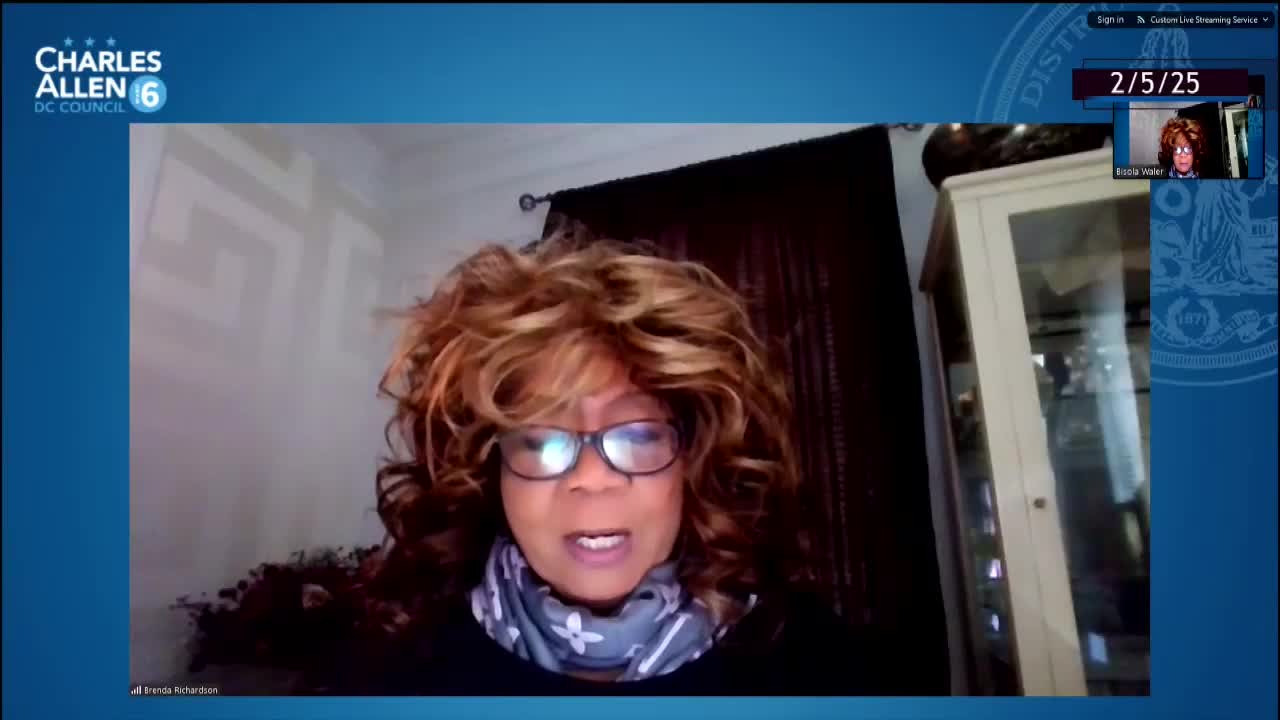
Brenda Lee Richardson, coordinator of the Anacostia Parks and Community Collaborative, told the committee: "The benefits of urban trees are many. They help manage our city's storm water, clean the air we breathe and provide shade on a hot summer day." She said money alone will not address long-standing canopy inequities and urged the council to pass two bills to protect trees on both private and public land.
Nonprofit leaders described two legislative priorities. Richardson and others backed the Tree Preservation Enhancement Amendment Act, which panelists said would lower the diameter threshold for special-tree protections from 44 to 25 inches and increase permit transparency for private removals. They also urged passage of the Office of Natural Area Conservation Establishment Act, which proponents say would clarify which agencies manage roughly 500 acres of forested public land and create a city roadmap to control invasive plant species.
Nathan Harrington, founder and director of Ward 8 Woods Conservancy, recommended placing management of undeveloped, forested public land with a dedicated office. He raised concerns about how the hazardous-tree designation is applied for private removals and warned that a broad use of the “hazardous” category can be used to remove large canopy trees without fees or mitigation. "Declaring every aging tree hazardous is a recipe for rapid deforestation," Harrington said.
KC Trees and neighborhood partners urged DDOT's Urban Forestry Division to pilot community-based stewardship for street trees — from watering and initial structural pruning to reporting and re-staking — as a way to protect the city’s investment in new plantings. KC Trees' representative noted the city has planted tens of thousands of young street trees in recent years and that water and early pruning are the most basic determinants of early survival.
Capital Nature's cofounder Stella Tarney asked DDOT to include tree-care partners in climate resilience working groups and to coordinate drought-response plans to protect newly planted trees. "We have interacted with UFD arborists as part of our neighborhood engagement work," Tarney said. She urged a stronger partnership program that would enable local stewards to help with watering and short-term care.
Council members pressed for clearer survival metrics for transplanted heritage trees and for a pilot on community stewardship. Committee members said they would press DDOT to respond publicly at next week's agency oversight hearing and to provide the department's proposed parameters for any community stewardship pilot.
Ending: Panelists called for faster council action on the two bills and for DDOT to spell out how a community-maintenance pilot would work, including responsibilities, training, and reporting metrics.