Lifetime Citizen Portal Access — AI Briefings, Alerts & Unlimited Follows
Massachusetts unveils SHIELD working group and $47 million package to grow defense innovation
Loading...
Summary
Massachusetts Governor Maura Healey announced an executive order to create SHIELD, a working group to coordinate defense-sector innovation, and outlined $47,000,000 in state investments and grants to expand microelectronics, biomedical and base-aligned defense work across the Commonwealth.
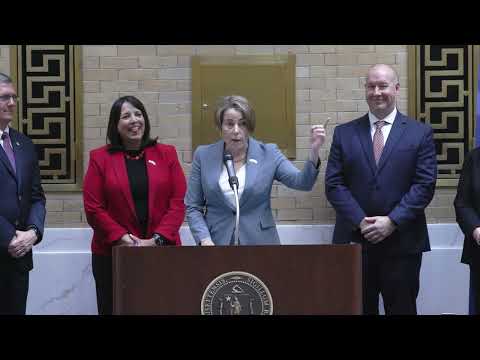
Massachusetts Governor Maura Healey on Thursday announced plans to sign an executive order creating a working group called SHIELD (Strategic Hub for Innovation, Exchange, and Leadership in Defense) and outlined $47,000,000 in state investments to accelerate defense-related innovation and economic growth.
"First, I'll be signing an executive order, an executive order to advance the defense sector innovation, and economic growth for our state," Governor Maura Healey said, describing steps for state agencies to review systems and support partnerships.
The executive order, Healey said, will establish SHIELD to coordinate public-private collaboration on matters ranging from workforce development to funding and contracting. Economic Development Secretary Eric Paley told the convening the initiative will be integrated into the administration's business front door to make it easier for firms to find contracts, funding and partnerships in Massachusetts.
As part of the announcement, the administration described a set of targeted investments: a $25,000,000 commitment to support Draper Laboratories' planned Impact Center in Lowell (part of the Lowell Innovation Network Corridor, or LINC); a $3,000,000 state investment in a Natick Soldier Systems Center "BioNexus" effort that the administration said leverages a $7,000,000 Army investment; and a $1,000,000 investment to help small businesses partner with the U.S. Air Force at Hanscom Air Base.
Dr. Jerry Wolitz, chief executive officer of Draper Laboratories, described the Lowell project as a manufacturing and packaging facility for advanced microelectronics that the partners expect to target a 2028 completion and to support roughly 200 jobs. "The $25,000,000 is more than an investment in a building. It's an investment in cultivating talent that leads the creation of new jobs," Wolitz said.
MassTech announced details of a SCALE (Supporting Chip Advancement from Lab to Enterprise) grant round tied to the Northeast Microelectronics Coalition (NEMC) hub. Carolyn Kirk, chief executive officer of MassTech, said SCALE will award $10,200,000 to 10 projects across three categories: ecosystem development, workforce development and technology development. Sample award amounts and recipients announced by MassTech included:
- MIT Lincoln Laboratory: $3,900,000 for RF and advanced materials work (Lexington). - North Shore Community College: $1,400,000 to establish a semiconductor workforce pathway. - Bridgewater State University: $1,100,000 for a shared-use photonics testing and packaging facility. - Tufts University: $353,000 for a high-resolution x-ray diffraction system (Medford). - Berkshire Community College: $202,000 for an advanced manufacturing and mechatronics workforce program (Pittsfield). - Harvard Center for Nanoscale Systems and other awardees were named; in several cases MassTech listed project descriptions but left precise award amounts or project locations as "not specified" in the announcement.
Carolyn Kirk said the SCALE grants and NEMC hub activity are intended to lower barriers to entry in microelectronics and help translate lab work to firms and jobs. "These awards are opening new doors and new tools, new resources that we'll be able to use and share with the broader NEMC coalition," Kirk said.
General Tim Ray, president and CEO of Business Executives for National Security (BENS), urged private-sector mobilization and regional coordination to ensure the United States remains competitive in technologies such as biotech and quantum. "This is a whole of society conversation," Ray said.
The administration framed the announcements as both economic development and national-security planning. Secretary Paley described the defense sector as a roughly $50,000,000,000 industry for Massachusetts supporting about 140,000 jobs and said the state will prioritize defense in its front-door service to business.
Officials said SHIELD and the announced investments will be implemented through existing state agencies and quasi-public partners including MassTech, MassDevelopment and others. Several agencies and local partners were named as implementation leads; the governor said the executive order will align cabinet secretaries and outside partners to carry out the plan.
The governor and other speakers characterized the measures as commitments to be operationalized by state agencies and partners; the administration did not present a formal legislative vote or ordinance at the convening.
What remains to be specified: the announcement included several dollar amounts and recipient names, but in some cases MassTech read project descriptions where the precise award amount or the expected timeline for disbursement was not specified at the event. Implementation details, such as grant contracts, procurement timelines, and formal approvals required to disburse state funds, were not described in the on-stage remarks.
The convening closed with the administration indicating a plan to finalize and sign the executive order and to move the SHIELD working group and funded projects into implementation.