Gulf County officials defend permitting rules as private providers draw criticism
Summary
County planning and building staff told commissioners that private plan reviewers and inspectors routinely omit checks required by local land-development rules and federal coastal regulations, and urged protections for consumers and the county before broadening private-provider use.
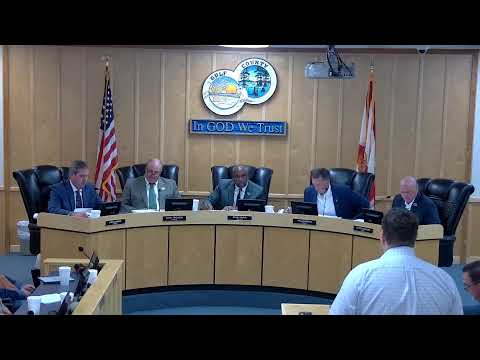
GULF COUNTY, Fla. — County planning and building staff spent more than 20 minutes telling the Board of County Commissioners on Oct. 28 that private plan reviewers and private inspectors are creating compliance and public-safety risks by failing to check local land-development rules and by avoiding site visits.
The county—s presentation, delivered during routine business, said private reviewers typically check only Florida Building Code items and often do not verify property ownership, legal access, impervious-area limits, setbacks, habitat conservation overlay requirements, Army Corps easements or FEMA flood-zone compliance. Staff also described at least one pool installation that lacked self-closing gates and door alarms that were discovered only after repeated site visits by county staff.
Why it matters: Gulf County enforces a 30 percent impervious-area limit along much of its coast and carries federally required habitat-conservation responsibilities. Staff told the commission that gaps in private reviews could produce downstream liability, safety hazards and additional county enforcement costs — and that private providers rarely accept long-term indemnification of that liability.
Details: Planning staff compared a county plan-check fee for a hypothetical 2,500-square-foot house to the smaller fee charged by private reviewers and said the private reviewers do not perform site checks tied to local rules. The planner said that when private reviewers sign off, county staff often need to require corrections later because the plans did not reflect local setbacks, dune permits, wetland delineations or other locally required approvals.
Staff argued that those omissions can produce public-safety risks (for example, noncompliant pool gates and missing alarms) and property impacts (excess impervious surface that increases neighborhood flooding). The county noted it enforces multiple coastal and stormwater rules designed to avoid flooding neighbors and to remain in compliance with federal programs.
What commissioners did: The discussion was informational; no ordinance or fee change was adopted at the meeting. Commissioners and staff said they would continue to pursue clearer communication to the public about what county reviews cover and will explore whether private providers can be required to accept indemnification or otherwise assume responsibilities they now leave with the county.
Context: The discussion referenced social-media criticism from a group called Red Tape Florida and private-provider complaints about county fees. County staff said they have not received direct calls to explain the fee and that some social-media threads are driven by private providers.
Ending: County staff said they will continue outreach and monitor private-provider performance, and reiterated that any changes to the county—s inspection or plan-review policies would be brought back to the commission for formal action.
AI generated
The text on this page is AI generated. Summaries, highlights, analysis, and video transcripts are all produced from the original source material.
AI can make mistakes, so if you spot one, and we will fix it for everyone.
Note: the source content is unaltered by us. Any content source we link to, be it a video, an audio recording, or a document, is presented exactly as its publisher released it. That publisher is usually a government body, sometimes an individual official or another organisation.