Get AI Briefings, Transcripts & Alerts on Local & National Government Meetings — Forever.
Edgecombe County OKs UDO change to allow data centers, requires engineered 60 dBA limit at property line
Summary
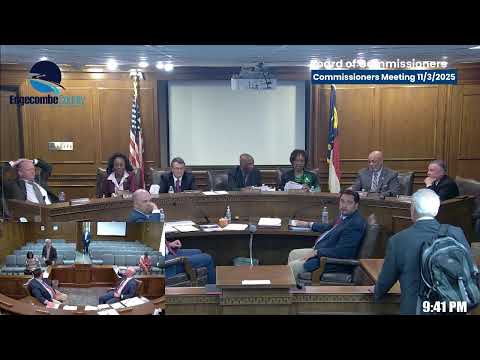
The Edgecombe County Board of Commissioners voted Nov. 3 to amend the county’s Unified Development Ordinance to add data centers and crypto‑mining operations in M‑2 zones with new development standards, including a requirement that projects be engineered not to exceed 60 dBA at the property line.
The Edgecombe County Board of Commissioners voted Nov. 3, 2025 to adopt a text amendment to the Unified Development Ordinance that adds data centers and crypto‑mining operations as permissible uses in the county’s General Industrial (M‑2) zoning district, subject to new development standards and verification requirements.
The amendment allows data centers as a by‑right use in M‑2 and permits crypto‑mining operations through conditional rezoning or as part of a planned development. During a public hearing, county planning director Durbin Veil reviewed the draft language: required neighborhood meetings (to be held after application submittal and no later than 10 days before the planning‑board meeting), minimum setbacks of 100 feet (expanded to 500 feet where the M‑2 parcel shares a lot line with a residential property that has an existing or approved dwelling), mandatory Type C buffers, and a requirement that applicants submit attestations of electrical and water capacity from public utility providers as part of building‑permit and annual zoning‑compliance reviews.
Why it matters: proponents at the hearing said the change could unlock large investments in Kingsborough Industrial Park and nearby M‑2 parcels, including planned on‑site power generation and energy storage that developers said would provide surplus electricity back to the regional grid. Opponents and residents raised concerns about potential noise, environmental impacts, and the adequacy of local oversight.
Noise and measurement standards: staff initially proposed maximum sound levels of 60 dBA during daytime hours (7 a.m.–6 p.m.) and 50 dBA at night. The staff report and planning‑board discussion compared those figures with other UDO standards (for many industrial uses the ordinance sets a 70 dBA maximum measured at a property line or no closer than 100 feet; wind energy conversions are limited to 55 dBA). Staff presented short‑duration ambient readings taken at multiple sample points around Kingsborough that ranged roughly from the low‑50s to mid‑60s dBA during daytime sampling. Commissioners considered three options: keep 60/50 dBA; increase to 70/55 dBA; or adopt an ambient‑based standard that would require a third‑party determination and prohibit increases above measured ambient noise.
Board action and limiting condition: after hearing public comment and staff presentations, a motion carried to approve TA‑25 with the listed development standards and an additional requirement that proposed projects be engineered so as not to exceed 60 dBA measured at the project property line. The motion passed by voice vote with no recorded roll‑call opposition.
Other development standards and requirements: the adopted UDO amendment requires third‑party verification of noise limits (paid for by the applicant but selected by the county), attestation of utility capacity whenever electricity from a public provider is used in any amount (including for incidental uses), and that on‑site generators be fully enclosed, meet applicable fire standards and hold required state and federal permits. The amendment preserves the board’s ability to require additional conditions on county‑owned parcels or through conditional rezoning agreements, including possible bonding or permit conditions if the applicant consents.
What proponents said: several economic‑development speakers — including representatives of Energy Storage Solutions, Carolina’s Gateway Partnership, and a local electrical engineer who consults on transmission and generation — described plans that would pair data centers with on‑site natural‑gas generation and battery storage. They argued the projects would increase local tax revenue, support existing industry by increasing available power, and create jobs. Developers and an insurance broker offered to use surety and decommissioning bonds, completion bonds and permit bonds to provide financial assurances to the county, but staff advised that such requirements cannot be universally mandated for permitted M‑2 uses through the UDO itself; bonds could be required as a negotiated condition of a conditional rezoning or of sale of county‑owned land.
What opponents said: speakers urged caution and more time to evaluate environmental and public‑health risks, and raised questions about long‑term decommissioning and the community impacts of power generation and cooling equipment. Residents pressed staff and commissioners on whether the approved 60 dBA standard would adequately protect neighbors given observed ambient levels.
Next steps: the amendment is now part of the Edgecombe County UDO. Future proposed projects within M‑2 will be reviewed under the new standards; projects requiring conditional rezoning or involving county‑owned parcels may be subject to negotiated conditions, including possible financial assurances or sale conditions. The county also established the third‑party verification process and clarified that applicants must demonstrate utility capacity when any public electricity is used.
Provenance: Staff presentation and the public hearing on the UDO text amendment appear throughout the meeting transcript beginning with the clerk’s public‑notice reading at the start of the hearing and continuing through staff slides, public comment, and the final motion and vote (see transcript segments starting 00:24:28 and concluding at 01:41:19).