Get Full Government Meeting Transcripts, Videos, & Alerts Forever!
Get email alerts on the Strategic Plan topic
No spam. Unsubscribe anytime.
Douglas County CJCC adopts 2025–27 strategic plan, sets data and communications workgroups
Summary
The Douglas County Criminal Justice Coordinating Council on Feb. 2025 unanimously adopted a 2025–2027 strategic plan that lays out four priority areas and an initial timetable for implementation.
The Douglas County Criminal Justice Coordinating Council on Feb. 2025 unanimously adopted a 2025–2027 strategic plan that lays out four priority areas and an initial timetable for implementation.
Patrick Schmitz, chair of the strategic-planning committee, presented the plan to the council and described the process used to develop it, including six focus groups, an online community survey, a system-wide data template and a 1½-day retreat that produced goals, objectives and action items. “We set out a very ambitious goal this summer to begin a process for developing our strategic plan,” Schmitz said during the presentation.
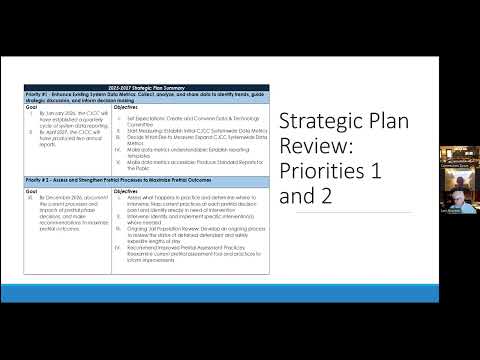
The plan’s four priority areas are: enhance existing system data metrics to collect and share consistent data across agencies; assess and strengthen pretrial processes to maximize pretrial outcomes; improve public-safety outcomes by expanding a continuum of criminal-justice program options that address crime-contributing factors; and develop a strategic communications plan to better publicize CJCC work and progress.
“Data was really important,” Schmitz said, explaining why standardizing data collection became the first listed priority. He told the council the group learned from issuing a data template that gathering consistent quantitative information across agencies is difficult but critical to inform decisions.
Pam Wiegand, director of criminal justice services, described continuing work already underway on pretrial assessment and the local praxis used to set supervision levels. She said the county updates that tool iteratively and is awaiting a separate state committee’s findings that could affect local practice. “We keep tweaking it based on the data,” Wiegand said.
Jessica Glendening, chair of the CJCC, framed the plan as a three-year guide rather than a rigid limit. “Some of these are probably not completely achievable within the 3 year plan time frame we’ve given ourselves, but we still have to get started,” she said, adding the plan should not prevent the council from addressing emergent “hot issues.”
The council moved to adopt the plan by motion; Schmitz moved to adopt and Wiegand seconded. After a show-of-hands vote that included online members, Glendening announced, “That looks like a unanimous vote, so we will move forward with this as our strategic plan.” The minutes and presentation materials will be posted publicly, Katie Fitzgerald said.
Implementation steps the council set during the meeting include: agencies that will provide data must identify a point person to work with Katie Fitzgerald so a Data & Technology committee can be chartered; Fitzgerald will contact each agency to assemble the committee and report back at the April meeting with a proposed membership and charter. For communications, Fitzgerald and Carrie Britt (Douglas County public information officer) will convene local agency PIOs and return to the CJCC in April with a proposed structure to develop a strategic communications plan.
Council members were explicitly asked to identify “actionable” agency representatives — staff who can commit to tasks without repeatedly returning for approvals — and to name staff who will participate in the workgroups. The plan’s detailed objectives and strategies are in an accompanying multi‑page document developed by the workgroup and JMI, which the council distributed to members for review prior to the vote.
Next steps: the CJCC will track progress against the plan’s milestones at future meetings, beginning with the April 8 meeting where the Data & Technology committee charter and the communications group’s proposed membership are expected to be presented. Public comment can be submitted to cjcc@dgc0ks.gov and the CJCC materials will be posted on the county website.
Because the document before the council is a final draft adopted by vote, this article reports adoption and the implementation assignments as recorded in the meeting. Where the meeting did not provide numeric vote counts, the council’s roll-call method was a show of hands and the chair characterized the result as unanimous.