Lifetime Citizen Portal Access — AI Briefings, Alerts & Unlimited Follows
UN representative outlines Iraq election preparations, returns from Al Hol and Yazidi land-rights steps
Loading...
Summary
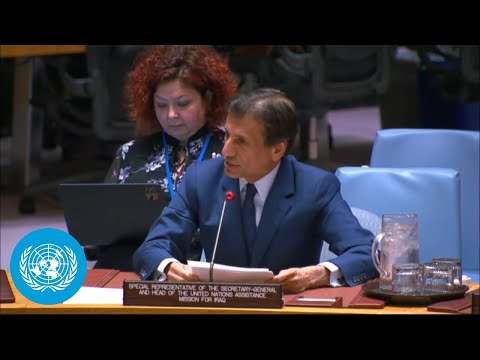
Mohammed Al Hassan addressing the United Nations Security Council reported on political, humanitarian and human-rights developments in Iraq, including preparations for a Nov. 11 national parliamentary election, returns from northeast Syria, internally displaced persons needs, and the planned drawdown of the UN Assistance Mission for Iraq (UNAMI).
Mohammed Al Hassan addressing the United Nations Security Council reported on political, humanitarian and human-rights developments in Iraq, including preparations for a Nov. 11 national parliamentary election, returns from northeast Syria, internally displaced persons needs, and the planned drawdown of the UN Assistance Mission for Iraq (UNAMI).
Al Hassan said Iraq is "well on its way" to the November parliamentary election and that the Independent High Electoral Commission (IHEC), with UNAMI technical support, is making "notable progress" in preparations. He said voter registration is set to conclude in the coming days and that "nearly three-quarters of total voters have completed biometric registration so far," while acknowledging "challenges, including logistical concerns." He added that IHEC is committed to efforts toward a free, fair and transparent election with participation "of all Iraqis without fear and intimidation," and that UNAMI would provide professional technical support to promote participation by women, youth and minorities.
Six months after the Kurdistan Region's successful October parliamentary election, Al Hassan said formation of a regional government remained pending and urged a "spirit of compromise" and continued dialogue grounded in the Constitution of Iraq to resolve outstanding issues between Baghdad and Erbil.
On returns, Al Hassan reported that more than 800 Iraqis had returned 10 days earlier from Al Hol camp in northeast Syria to the Al Amal Centre in Iraq. He said the government and the United Nations had supported the returns but emphasized that "adequate resources" are essential to ensure a dignified reintegration of returning families and to ensure a fair judicial process for detainees being repatriated.
The representative highlighted the ongoing humanitarian situation for internally displaced persons, saying "hundreds of thousands" remain displaced in Iraq and specifically noting about 100,000 Yazidi people from Sinjar (also spelled Sinjar) who live in IDP camps and informal settlements under precarious conditions. He said the Iraqi government had recently recognized Yazidi land rights by issuing more than 1,300 ownership letters and nearly 100 deeds or titles this year and noted proactive measures on compensation for Yazidi survivors and other minorities, while warning that sustainable returns will require coherent political, administrative and security measures plus investment in job creation and local services.
Turning to human-rights developments, Al Hassan recalled Iraq's January review under the Human Rights Council's Universal Periodic Review, noting that 263 recommendations are being considered and that progress is under way on a draft law concerning minority rights and on a national strategy to counter hate speech. He said the United Nations stood ready to continue supporting these initiatives and to explore options for continuing such support after UNAMI's departure.
On bilateral issues with Kuwait, Al Hassan welcomed expanded field missions and the use of advanced technologies to identify burial sites and witnesses; he urged accelerated efforts to locate the remains of roughly 300 missing Kuwaiti nationals and to recover missing property, including the National Archives of Kuwait. He also welcomed the decision to reactivate the Iraq–Kuwait joint committee on missing property and said renewed technical and legal committee meetings on maritime delimitation beyond marker 162 were a "welcome development" for rebuilding trust.
Regarding the UN mission, Al Hassan told the council that with just over six months remaining before UNAMI's mandate ends, the mission is following a structured transition schedule in close cooperation with the government of Iraq. He reported that UNAMI had closed offices in Mosul, Al-Amarah and Kirkuk and that staffing levels are being gradually reduced as the mission balances drawdown tasks with continuing mandated responsibilities amid broad United Nations financial constraints.
The council speaker closed by reiterating confidence in the resilience of the Iraqi people and the determination of their leaders, and by thanking members for their attention and support.