Get Full Government Meeting Transcripts, Videos, & Alerts Forever!
Get email alerts on the Water Infrastructure topic
No spam. Unsubscribe anytime.
Huber Heights to pursue tap-in district for Bellefontaine-area waterline extensions; staff to draft ordinance and contact residents
Summary
Huber Heights city staff presented cost estimates to extend public water to about 18 lots near Bellefontaine Road and the council asked staff to draft a tap-in district ordinance and do resident outreach rather than approve an immediate project.
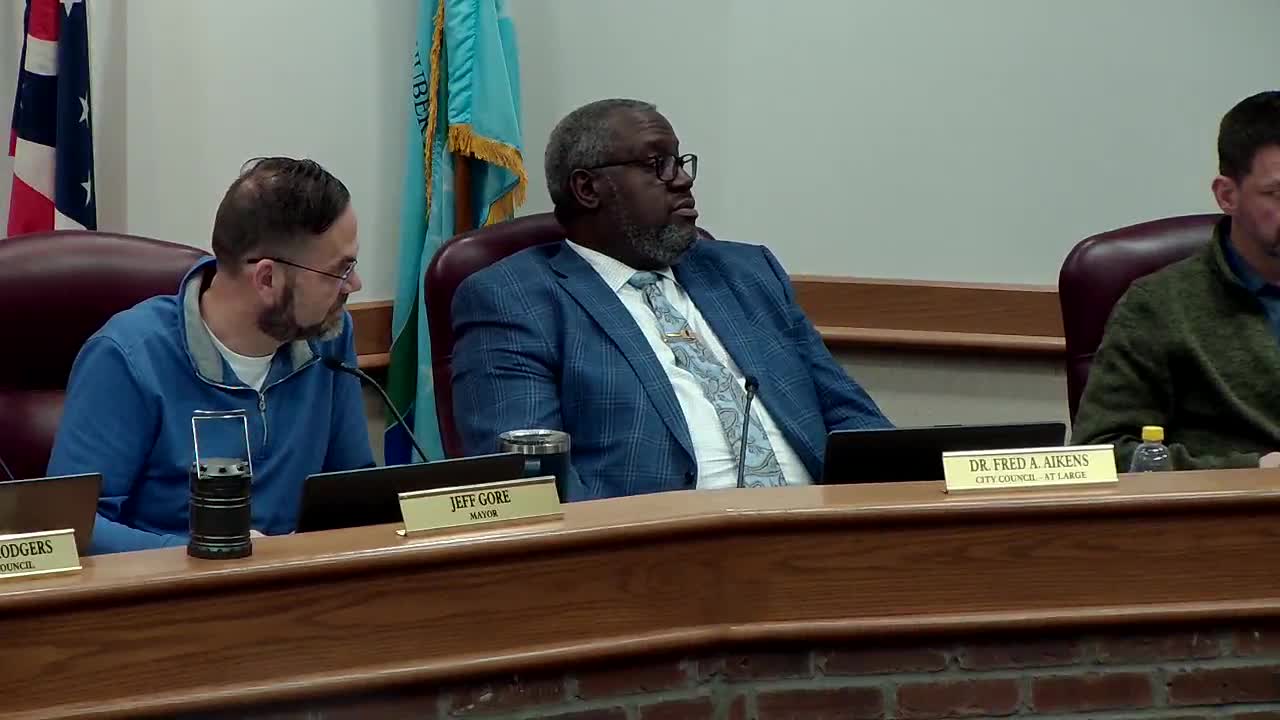
City staff briefed the Huber Heights council on a proposed waterline-extension project to serve properties around Bellefontaine Road, and the council agreed to have staff prepare a tap-in district ordinance and do outreach to potentially affected property owners.
Aaron (staff member) presented an engineer’s estimate of about $374,000 to extend public water to 18 lots in the Bethel/Womack/Bellefontaine area, which would equal roughly $21,000 per lot if the full cost were assessed to property owners. Staff noted prior precedent: a 2018 Mark Avenue special-tap project required two of three property owners to sign a petition and capped homeowner assessments at $5,000; the city covered the remaining project cost.
To make a connection affordable for existing homeowners, staff described using the municipal assessment process and a tap-in district. Options discussed included (a) a 10-year assessment period (current practice), (b) extending assessments to 20 years to lower annual cost, or (c) combining a property-tax assessment with a modest monthly water-bill surcharge specific to the tap-in district. Staff said state law allows assessments up to the life of the asset and that the city could choose the assessment term.
Staff suggested capping homeowner out-of-pocket cost to make tapping into the new main “approachable.” Council discussed examples: a $7,500 cap (staff’s illustrative midpoint between prior $5,000 precedent and higher per-lot costs) spread over 10 years would be about $750 a year (about $62 a month) before any county assessment fees; splitting that cost over 20 years or adding a small monthly surcharge could reduce the semiannual tax-assessment payment to roughly $187 a half-year in one illustrative scenario.
Council members asked staff to model several scenarios, including the number of homes that would likely petition for hookup, how assessments would be calculated if only some property owners choose to tap in, and whether existing infrastructure replacement plans could be used to phase construction. Aaron said staff will use petitions or interest surveys to determine how many property owners participate; typically the city requires a minimum petition percentage (for prior projects council required signatures from 60% where applicable) before work proceeds.
Council did not adopt an ordinance at the work session. Instead, members agreed that staff should draft the tap-in district legislation, prepare cost scenarios (10- and 20-year spreads, assessment interest or collection fees, and monthly-billing options), and contact the affected residents. Staff signaled it could begin design work (a nine- to 12-month process from design through installation) if council directs it to proceed. The council expects a draft ordinance and outreach plan at a future meeting (not the Monday meeting), and staff will return with the boundary language, cost options and recommended petition thresholds.
Council members also discussed policy fairness between new development (where developers pay infrastructure costs) and existing lots, fire-protection benefits from added hydrants, and the potential long-term property-value increase for homes on public water. Staff noted some residents could retain private wells for irrigation but must avoid cross-connections to the public system.