Get email alerts on the Transportation Planning topic
No spam. Unsubscribe anytime.
Leander council accepts US-183 corridor study; staff given implementation toolbox
Summary
Council accepted the US-183 Corridor Study and its consolidated project list and implementation toolbox; acceptance does not obligate the city to program projects into the CIP but positions projects for regional and federal funding.
Consultants from Kimley-Horn presented the final US-183 Corridor Study, which includes a consolidated project list (intersection improvements, pedestrian crossings, grade separations at San Gabriel, Hero Way and Crystal Falls, shared-use paths aligned with the Bridal Line Trail, small park and placemaking elements) and a matrix matching projects to likely state and federal grant opportunities.
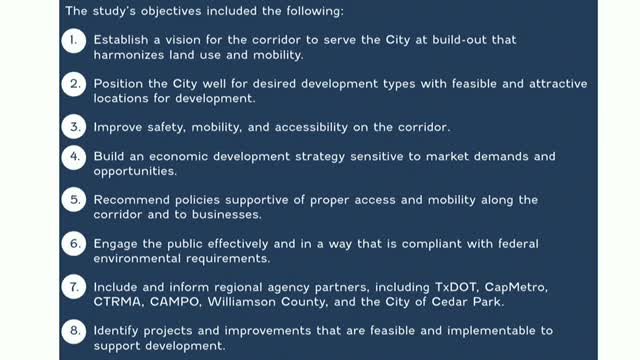
Ryan Graves and Lance Ballard reviewed the project objectives, the technical working-group process (which included City of Leander staff, City of Cedar Park, Williamson County, CAMPO, TxDOT and CapMetro), and public engagement results. The consultants said they had submitted the subset of intersection-focused projects to CAMPO's fiscally constrained list; those projects were accepted and staff said inclusion increases competitiveness for certain regional funding.
Council members asked clarifying questions about train-related congestion (consultants noted rail crossings and the corridor's bottleneck intersections as primary delay points), the consequences if TxDOT changes route designations, and how projects should be bundled for grant competitiveness. Consultants emphasized that acceptance of the study does not create a binding obligation to implement the projects or to program them in the CIP; instead, the study packages projects into logical grant-ready groupings and provides a suggested funding and application timetable.
Council voted unanimously to accept the study report. The motion to accept was made on the record and seconded; staff said the vote does not itself program funds or commit the city to future construction.
AI generated
The text on this page is AI generated. Summaries, highlights, analysis, and video transcripts are all produced from the original source material.
AI can make mistakes, so if you spot one, and we will fix it for everyone.
Note: the source content is unaltered by us. Any content source we link to, be it a video, an audio recording, or a document, is presented exactly as its publisher released it. That publisher is usually a government body, sometimes an individual official or another organisation.