Get AI Briefings, Transcripts & Alerts on Local & National Government Meetings — Forever.
Middleton District reviews phased design for new elementary school, staff cites $8 million set-aside
Loading...
Summary
District staff presented preliminary plans and asked the Middleton District board for input on a phased build of a new elementary school, saying cooperative funding combined with $8,000,000 the district has set aside would allow construction of an initial portion of the project that staff estimated at about $19,000,000 in total scope.
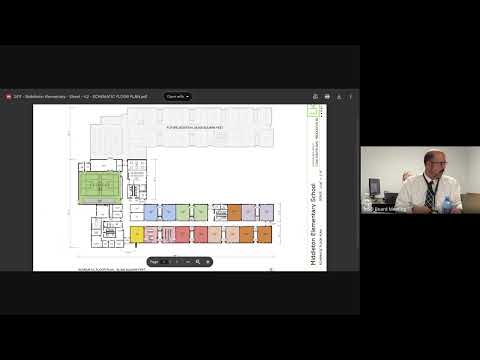
District staff presented preliminary plans and asked the Middleton District board for input on a phased build of a new elementary school, saying cooperative funding combined with $8,000,000 the district has set aside would allow construction of an initial portion of the project that staff estimated at about $19,000,000 in total scope. The presentation framed the work as a partial build now with mechanical and connection points included so future additions can be completed without reworking core systems.
"This meeting is primarily just to give you as a board an opportunity to get some input on the design of this school," said a District staff member, who led the presentation and review of the schematic layout. Staff said principals will review the design the next day and meet with the architect next Monday, after which the architect will prepare more detailed plans based on the board and principal input.
The presentation identified several design decisions for the board to consider. The largest was a change to how the dining and gym spaces are arranged: the gym would function as a multipurpose space during the initial phase, including serving lunch, while a kitchen would be designed to serve the gym and later flip to serve a permanent cafeteria when an addition is built. Staff described that as a cost- and schedule-driven strategy to keep the initial build smaller while preserving the ability to convert the space later.
Staff also proposed a smaller media center at first, with a removable wall in adjacent space so that the full media center could be created when the addition is completed. Other rooms were described as flexible: the putative testing room and the speech-language pathology (SLP) room could be converted to classroom space if enrollment requires it; art could be located in smaller dedicated space or taught in individual classrooms.
On capacity, staff noted the schematic shows about 16 classrooms; using an average of about 25 students per classroom, that initial phase would accommodate roughly 400 students. Board members pressed on restroom locations and capacity, with one member referencing operational crowding experienced during transitions at Purple Sage and urging planning to avoid bottlenecks for younger students.
Staff outlined administrative and support spaces, including two counselor offices, a principal’s office and a work/copy room, and said the City of Star has agreed verbally to place one of its officers in the building at no charge, providing a law enforcement presence without designating an assigned school resource officer. For site access, staff said Highway District 4 has approved the proposed bus and staff entrance and the parking layout.
Other implementation details discussed included modular HVAC units planned to be installed unit-by-unit to support phased construction, the likelihood that playground equipment will be deferred (the field will remain grass initially), and community donations being explored to fund future playground equipment. Staff said the architects will design future hookup points (plumbing, mechanical, structural) so systems are ready when additions are constructed.
Board members raised programmatic questions including how to configure grade spans (K–3 vs. K–5) depending on enrollment and nearby development, and whether small spaces such as coat rooms should be removed to save square footage and stretch the budget. Staff said those tradeoffs will be analyzed as architects develop more detailed drawings and as enrollment and bond/tax decisions are clarified.
Procedural actions recorded in the meeting included a motion to approve the agenda early in the session and an adjournment at the end; both were moved and seconded and accepted by voice vote. Staff concluded by saying they would compile the board’s notes and principal feedback and deliver them to the architect for the next design iteration.
Implementation next steps identified in the meeting were a principals’ review the following day, an architect meeting next Monday to take that feedback, and production of more detailed plans thereafter. Staff stressed the initial build will include connection points for later expansion so that the district can add the cafeteria and larger media center without redoing core systems.
Details not specified in the meeting transcript included the exact amount contributed by the cooperative fund, any final guaranteed maximum price, the bond timetable or vote schedule needed to fund full build-out, and names for some board members who spoke during procedural items.