Get Full Government Meeting Transcripts, Videos, & Alerts Forever!
Get email alerts on the Land Use topic
No spam. Unsubscribe anytime.
Snowmass caucus's overlay amendments pass first reading after hours-long debate over irrigation, lighting and seed mixes
Summary
Pitkin County commissioners advanced overlay-district code amendments on first reading Nov. 5 after a multi-hour hearing focused on irrigation efficiency, night-lighting rules and permitted housing types; staff and the Snowmass caucus were directed to refine irrigation, seed-mix, mulch and lighting language before second reading.
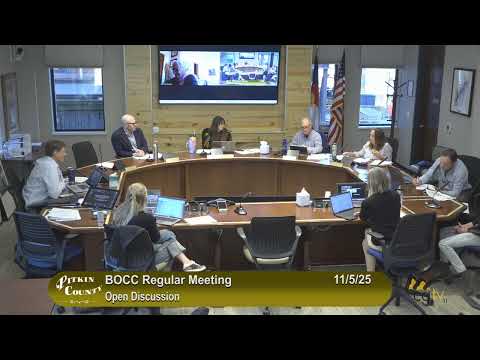
The Pitkin County Board of County Commissioners completed a lengthy first reading and public hearing on proposed land-use code amendments for the Valleys of Capitol Creek and Lower Snowmass Creek Overlay District, voting to advance the measure while directing the Snowmass caucus and county staff to refine several technical provisions.
The text changes were drafted by the Snowmass Capitol Creek Caucus and presented by consultant Tim Malloy. The package reemphasizes the overlay's 5,750-square-foot residential maximum and adds detailed site-siting and residential-development standards addressing building orientation, preservation of irrigated agricultural lands, landscape irrigation and restrictions on some new residential use types. Planning & Zoning voted 4-0 to recommend the caucus's proposal with a few edits; the board accepted the P&Z recommendation on first reading.
Key issues raised during the hearing included:
- Irrigation standards: the caucus and consultant explained provisions aimed at improving water efficiency for residential landscaping and gardens, including smart-irrigation sensors and limits on high-water turf. Commissioners and staff pressed for clarity on whether the provisions were meant to apply to large agricultural irrigation systems (hayfields and flood irrigation) or only to residential garden irrigation tied to new development. Ned Andrews, chair of the Snowmass caucus, said the caucus intended the irrigation provisions primarily for residential landscaping near dwellings, not to mandate conversion of broad-scale agricultural systems.
- Seed mixes and mulch: the caucus proposed encouraging native-seed mixes and a minimum mulch depth in planting beds to reduce evaporation. Commissioners asked staff to avoid overly prescriptive language that would be hard to enforce countywide; staff noted practical enforcement challenges for exact mulch depths and for specifying a single 'Pitkin County native seed mix.' Commissioners asked staff to return with alternate wording that preserves the caucus's conservation aims but avoids impractical technical mandates.
- Night lighting and dark skies: the caucus sought stricter limits on nighttime lighting for recreational and event facilities. Dark-sky stakeholders attending the hearing stressed that limits help protect the valley's night environment; commissioners and staff asked for clearer definitions (for example, whether small courts like pickleball would fall under the ban) and for language that preserves narrow health-and-safety lighting exceptions.
- Permitted uses and housing types: the proposal would bar new free-market duplexes, multifamily buildings and mobile homes inside the overlay boundary while preserving the county's ability to allow deed-restricted workforce or on-site employee housing in specific circumstances. Commissioners asked staff to confirm the changes would not unintentionally block temporary or modular housing used during construction or bona fide employee housing tied to agricultural operations.
The board moved the ordinance on first reading and asked the caucus and staff to return for a second reading with clarified language on agricultural versus residential irrigation, seed-mix wording, mulch specification, and lighting definitions and exceptions. Commissioners explicitly asked for language that is enforceable in practice and that does not unintentionally preclude needed employee housing or temporary construction housing.
What's next: staff and the caucus will bring revised draft language to the board for second reading; Nov. 19 was suggested as a date for further land-use items, and staff indicated a December 3 second-reading hearing would be scheduled if more time is needed.