Get Full Government Meeting Transcripts, Videos, & Alerts Forever!
Get email alerts on the Competency Determination topic
No spam. Unsubscribe anytime.
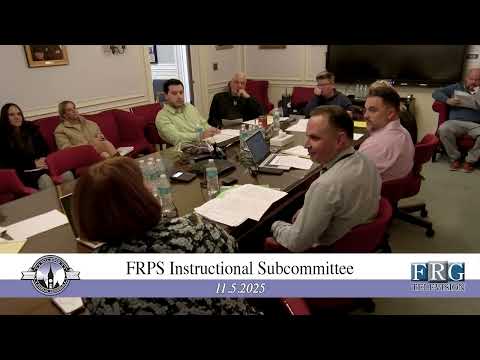
Fall River subcommittee refers draft competency-determination policy to full committee after debate over pathways to graduation
Summary
The Fall River City Instructional Subcommittee on Wednesday reviewed a draft competency-determination policy the district must file with the Massachusetts Department of Elementary and Secondary Education (DESE) after the state removed MCAS as a high-stakes graduation requirement.
The Fall River City Instructional Subcommittee on Wednesday reviewed a draft competency-determination policy the district must file with the Massachusetts Department of Elementary and Secondary Education (DESE) after the state removed MCAS as a high-stakes graduation requirement.
Staff said the policy — due to DESE in December — would require students to satisfactorily complete specified coursework in each content area (for example, Algebra I and Geometry and required ELA courses) and demonstrate mastery via one of several routes: district benchmark assessments, a course final, a performance task, a capstone or portfolio, suitable AP or SAT scores, or successful dual-enrollment coursework. “We wanted to provide multiple opportunities for kids to demonstrate competency,” Staff member said during the presentation.
Keith Michon, identified himself as “president of the former Educators Association,” argued against introducing any new end-of-course standardized exam as a graduation requirement. “I urge you to reject any graduation determination based on standardized tests, and instead allow students true choice and multiple avenues to demonstrate competency,” Michon said during public comment.
Presenters said the draft includes guidance on appeals, accommodations for students with disabilities and English learners, treatment of students who transfer in with prior exams, and options for credit recovery or selected performance tasks. The draft proposes explicit appeals-team membership: the building principal (or designee), the student’s school counselor, the relevant curriculum supervisor and, when appropriate, representatives from special education and English-as-a-second-language services.
Committee members pressed for clarity on implementation, record-keeping and monitoring. One member asked how the district would capture and transfer competency determinations for students who move between districts; staff said the district would build record-keeping tools to document how each student met the standard so receiving schools could recognize prior determinations. Several members asked for a follow-up report after one year of implementation showing how many students met competency through each option so the policy could be revisited if needed.
A motion to refer the draft competency-determination policy to the full school committee was made, seconded and put to a roll-call vote. During the recorded roll call, named committee members indicated support: Deb mister Dyers (recorded as “Yes”), Mister Corey (“Yes”) and Miss Flower (“Yes”). The motion was recorded as referred to the full committee for consideration.
What’s next: Staff will bring the draft to the full committee for review and is expected to submit the district’s competency-determination policy to DESE by the December deadline. The committee asked administration to return with implementation tools and early-year data showing which pathways students used to meet competency.