
Santa Fe County orders phased study on creating a public electric utility after extended debate
Get AI-powered insights, summaries, and transcripts
Subscribe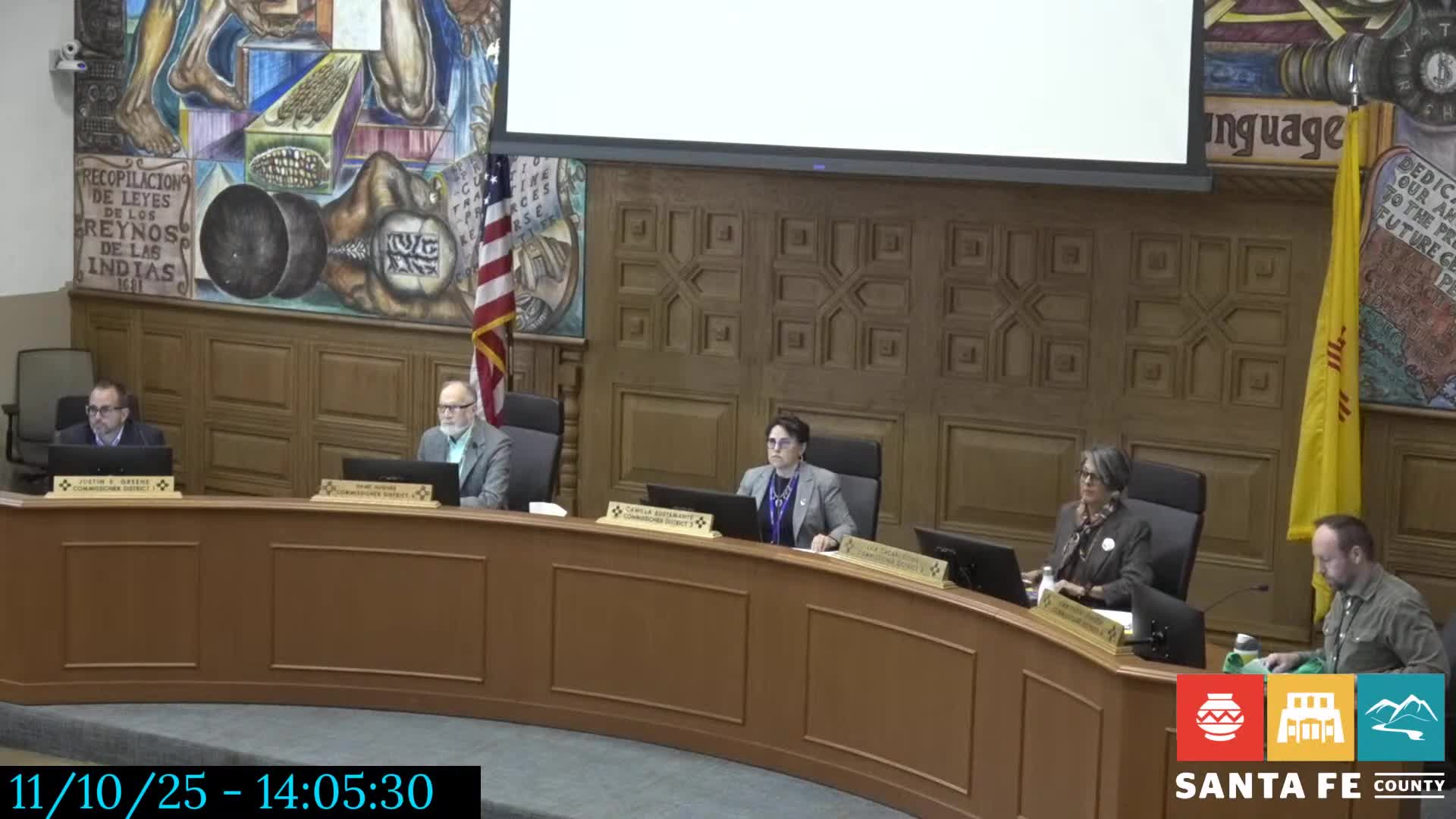
Summary
After hours of public comment and debate, the Santa Fe County Board of County Commissioners voted 4–1 to direct the county manager to commission a phased feasibility study into options for a publicly owned electric utility, including an initial 90‑day pre‑feasibility scan and a later full feasibility phase.
The Santa Fe County Board of County Commissioners voted Nov. 10 to direct the county manager to conduct a phased feasibility study to examine whether the county should pursue a publicly owned electric utility.
The resolution, sponsored by Commissioner Adam Johnson and co‑sponsored by Chair Camilla Bustamante, passed 4–1 with Commissioner Justin Green recorded in opposition. The board inserted a series of amendments establishing a staged approach: an initial pre‑feasibility scan to assess legal, technical and financial viability, a full feasibility phase with modeling and public engagement, and report‑backs to the commission after each phase.
Why it matters: supporters said the study will let Santa Fe County understand options ranging from microgrids and community energy pilots to larger, county‑owned models. Opponents — including representatives of New Mexico electric cooperatives and PNM — warned that a county utility could be costly, technically complex and risky for reliability.
At a packed public‑comment period preceding the vote, utility representatives told the board the status quo already offers community ownership through cooperatives and that splitting service areas could weaken existing grids. “We respectfully oppose the proposed resolution … as it determines the feasibility of creating a publicly owned electric utility,” said Vince Martinez, chief executive of the New Mexico Rural Electric Cooperative Association.
PNM’s representative, Sergio Matas Cisneros, told the commission PNM has invested in local grid improvements and is on track for steep reductions in carbon intensity: “PNM is on track to be 75–76% carbon free by ’26,” he said, and described a community benefits package associated with an infrastructure transaction the company is pursuing.
Supporters, including Public Power New Mexico and community groups, argued a study is the prudent first step. “This is not a commitment,” Alicia Shaw of Public Power New Mexico told the board; she said a study would evaluate options such as distributed solar, storage and microgrids for resilience and potential cost savings.
Commissioner Adam Johnson framed the measure as investigatory: the study will “explore the full spectrum of public power options available to Santa Fe County,” he said, citing local and national models. Commissioners debated scope, timeline and cost caps at length. Manager Mender Schaffer told the board a study scope could range widely, with staff estimating a meaningful study could cost in the low hundreds of thousands of dollars; commissioners discussed caps and staged procurement to keep early work small and rapid.
The outcome and next steps: the board approved resolution 2025‑124 (amended) directing staff to return a scope of work, initiate a Phase 1 pre‑feasibility assessment and procure consultants as necessary, with report‑backs required after each phase. The motion passed 4–1.
Quotes from the meeting capture the divide: “We need to understand what is the best way to do that,” Johnson said about county options. “There’s a range of options from total control to something more distributed,” he added. PNM’s Matas Cisneros emphasized existing investments, telling commissioners the company had recently put hundreds of millions into local infrastructure.
The study’s timeline and budget will be set through the procurement process; staff said it would return to the board with a scope and contract for approval before execution. The vote does not change existing service providers pending the outcome of the study.
What to watch: staff returns an RFP and proposed scope of work for the Phase 1 pre‑feasibility scan and the board’s procurement decisions on consultant selection.