Prescott Valley planners hear heated public testimony on ‘Government Tank’ general plan amendment
Loading...
Summary
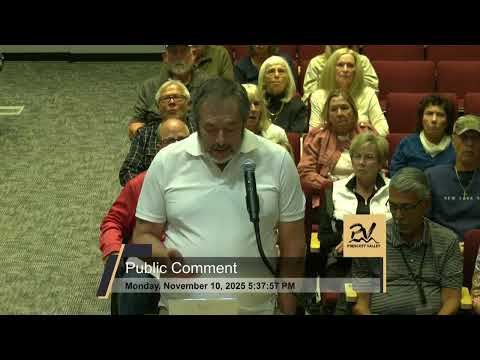
The Prescott Valley Planning and Zoning Commission heard hours of public testimony Nov. 10 on a request to amend the town’s general plan to allow a 40‑acre aggregate extraction site known as “Government Tank” to be designated industrial rather than Village PAD A1.
The Prescott Valley Planning and Zoning Commission heard hours of public testimony Nov. 10 on a request to amend the town’s general plan to allow a 40‑acre aggregate extraction site known as “Government Tank” to be designated industrial rather than Village PAD A1. The meeting was discussion‑only; the commission made no recommendation and will revisit the item at a later hearing and at town council per staff.
Interim Development Services Director Stacy Bristow told the commission the applicant’s petition triggered a major general plan amendment process and that notices were circulated to state and regional agencies. Staff presenter Chris Norlock said the applicant’s request resulted from a citizens’ petition and described the next steps: two planning and zoning hearings and a town council hearing before year’s end.
Bill Lally, attorney for the Fane family and the applicant, summarized site history and outreach, calling the parcel a roughly 40‑acre “hard rock” location chosen after two years of study. “This is just the major general plan amendment, not the zoning case,” Lally said, adding that a companion zoning case and a development agreement will follow. He described outreach using Slido software and said the operator, Asphalt Paving and Supply (AP&S), plans mitigation including water trucks, dust control and limiting on‑site processing.
Pete Thompson, representing AP&S, explained operational details and blasting procedures: crews drill and load charges for several weeks, and when detonated the event lasts “five seconds” while extraction continues in other areas. He said most crushing and refined processing would stay at AP&S’s existing facility and that water would be trucked in rather than drawn from groundwater; the operator also described a state‑approved reclamation plan and said lifetimes for the deposit will be uncertain until excavation begins (estimates ranged from several years to “10, 20, 30 years”).
Public testimony split along neighborhood lines. Opponents, including Sandy Graham of the Prescott Valley Citizens Alliance, said the change would conflict with the town’s recently updated general plan and warned rezoning residential PAD A1 to industrial would set a poor precedent. “Mining within the town limits is not an improvement to the general plan,” Graham said.
Supporters and nearby residents said the site is farther from homes than existing pits, that the region needs the rock for roads and development, and that AP&S has a long track record. Vic Paulson urged commissioners to “apply the governing ordinances based on fact” and said deeded surface water rights of about 250 acre‑feet are available to the project. Julio Vina, vice president of the Victorian Estates HOA, said Government Tank would put the nearest home nearly three miles away compared with under a third of a mile from the current site.
Several speakers pressed procedural and legal issues. William Max Hathaway and Patricia Betzel asked the commission to withhold substantive action until a final development agreement is available, saying state law requires consistency between development agreements and the general plan and that some donation/vesting terms being negotiated could affect long‑term town financing and land use. Commissioner King asked staff to check whether House Bill 2685 — reported to set a half‑mile minimum distance between mining and occupied residences — has been enacted; staff said they would verify the bill’s status.
The commission recorded Commissioner Joe Colosimo’s earlier statement that he would recuse himself from participation on this agenda item amid allegations from a local political group; Colosimo told the commission he believed the complaints were intimidation. “Therefore, I will regrettably recuse myself from any participation in the hearing,” he said; the clerk was asked to show the recusal in the record.
Commissioners asked the applicant to provide recommended conditions and to supply the finalized development agreement to the commission once it is completed. Staff and applicant said the development agreement (not contract zoning) would detail how the applicant would secure a replacement site and how gifting of west Fane Parkland to the town would be handled, and that the East‑of‑park county pit would remain permitted and is not proposed to close.
What happens next: the item will return for a subsequent planning and zoning hearing (a December date was referenced) and will later proceed to the town council. The commission took no formal vote on the general plan amendment at the Nov. 10 meeting.
Authorities and contextual details in the hearing included references to Prescott Valley’s 2035 general plan (approved 2022), state review agencies (ADEQ, ADWR), the State Mine Inspector and cited statutes on recusal (Arizona Revised Statutes §38‑503) and a referenced House bill (HB 2685) that staff agreed to research. The commission also received a CAFMA (fire authority) reference about access and structural road standards.
The hearing illustrated competing priorities: neighborhood preservation and public‑health concerns (blasting, dust, potential property‑value effects) versus operational needs for regional aggregate and a developer’s offer of parkland and a private haul road. The commission requested more documentation on blasting impacts, distance analyses, the development agreement and any legal constraints before making a recommendation.
The full record of public comments and staff materials will be available in the next commission packet; the commission did not act on GPA‑25‑001 at this meeting.