Poulsbo planner outlines Phase 1 of 2025 Critical Areas Ordinance update; stream buffers the biggest change
Loading...
Summary
Planner Nicole Coleman told the council that required state updates and new Department of Fish & Wildlife guidance will likely raise many stream "riparian management" buffers—staff described a 100-foot minimum buffer alternative and scheduled a public hearing in two weeks for the formal code amendments.
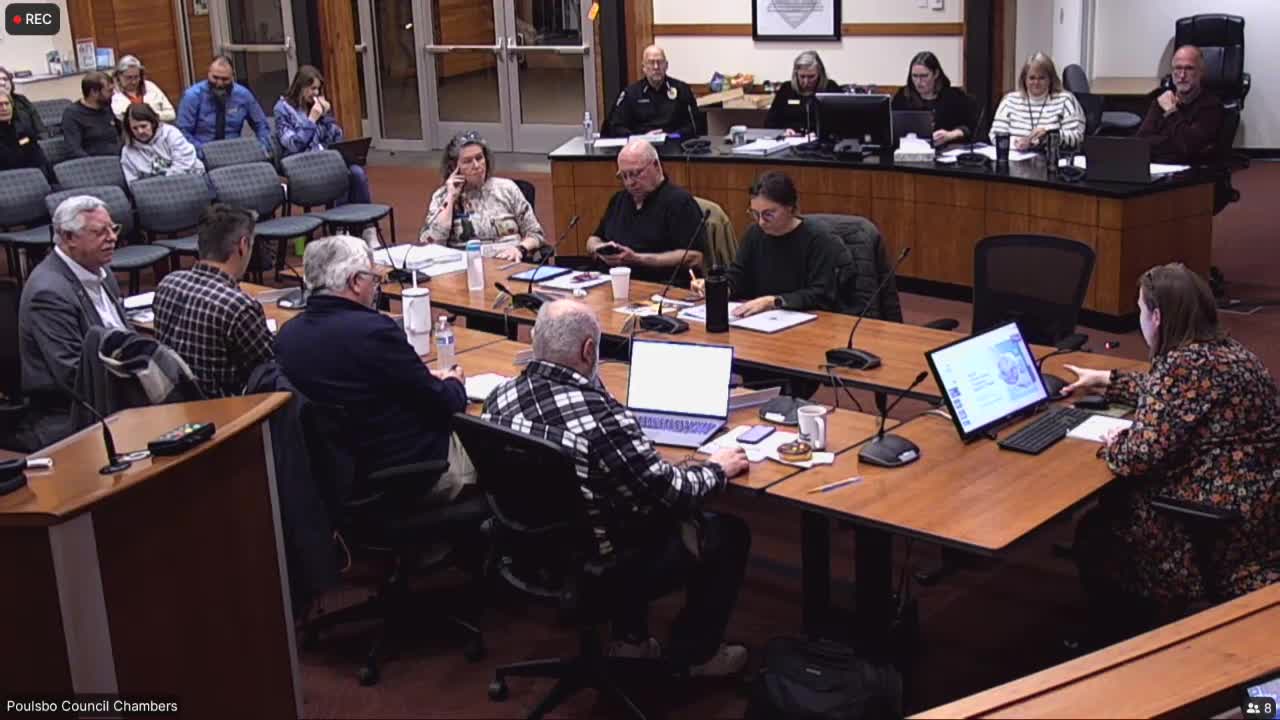
The Poulsbo City Council heard a detailed briefing Nov. 5 on Phase 1 of the 2025 Critical Areas Ordinance (CAO) update, the last regulatory piece of the city—s comprehensive-plan update.
Nicole Coleman, the city planner, said the Phase 1 package focuses on state-required changes and the "best available science" report the city contracted. She told council the biggest substantive shift is proposed changes to Fish and Wildlife Habitat Conservation Areas: the Department of Fish and Wildlife (DFW) now recommends riparian management approaches that could set a minimum 100-foot riparian zone for every stream type unless a site-specific, tree-height-based alternative is used.
"Based on the best available science, you either have to have a minimum of 100 feet for all streams, or you can use a site-potential-tree-height alternative," Coleman said at the meeting. She warned the tree-height alternative is complex to administer and could require property-specific studies that raise costs for homeowners.
Coleman said staff sent postcards to potentially affected property owners (roughly 150–200 addresses) and coordinated early with the Department of Fish and Wildlife, Department of Ecology, Department of Natural Resources, and the Suquamish Tribe. She reported that DNR recently submitted a comment letter requesting additional (discretionary) amendments; staff incorporated required changes for Phase 1 and said discretionary items will be considered in Phase 2.
Council members asked about interaction with shoreline rules, public-access requirements, and possible vegetation-management corridors to preserve community views. Coleman said the shoreline master program remains more restrictive in shoreline jurisdiction and that some visual-access or narrow vegetation-management approaches could be explored later.
Next steps: Coleman said staff will provide a marked-up strike-through version of the code to council members and that a public hearing is planned for Nov. 19. She recommended moving Phase 1 forward to meet state update requirements and returning Phase 2 (discretionary changes to improve usability and ADU affordability) in spring 2026.