Elko CAB backs adaptive Elk Species Management Plan and creation of Elk Management Subcommittee
Loading...
Summary
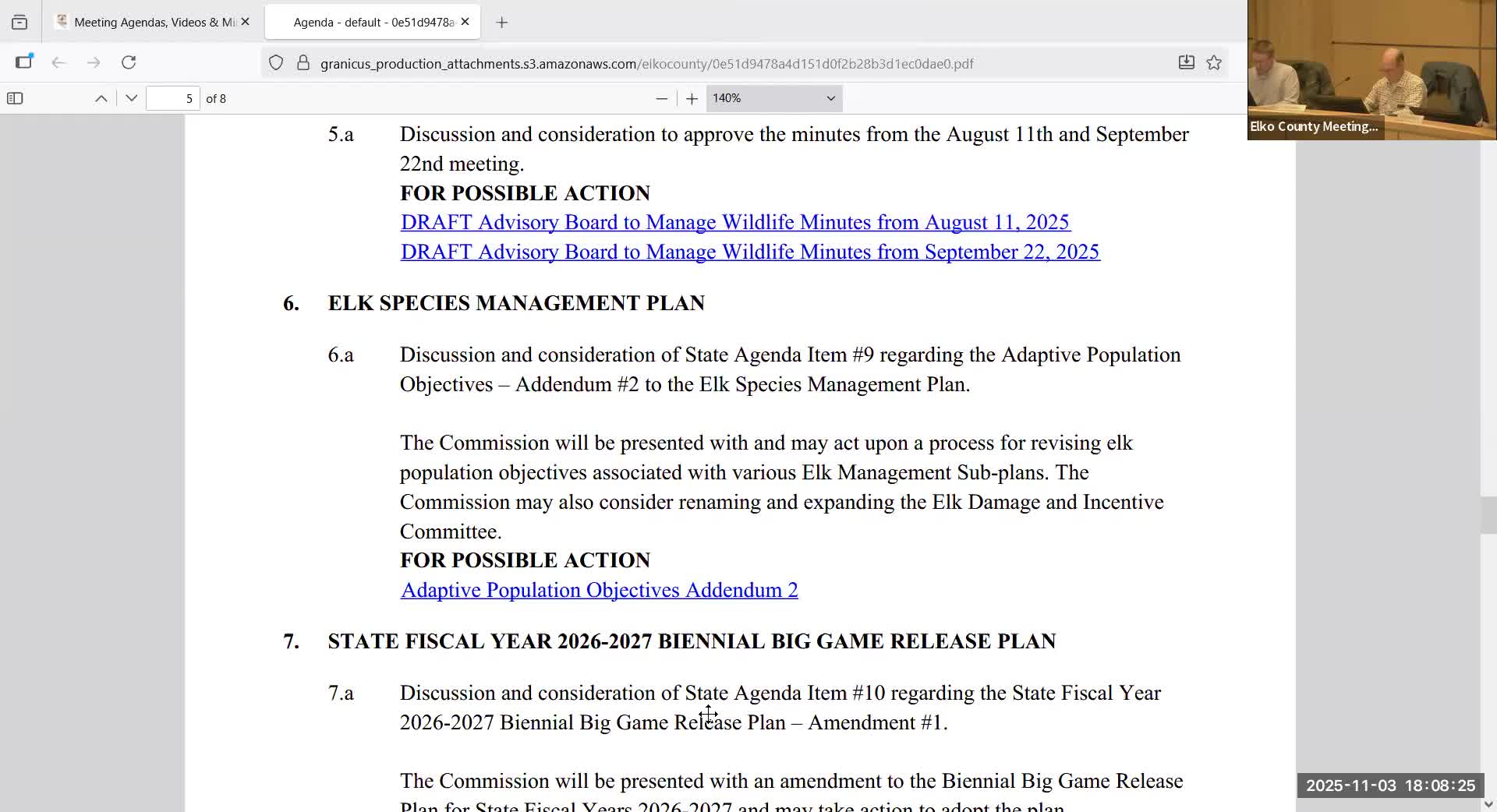
The Elko County Advisory Board voted to support Addendum No. 2 to the Elk Species Management Plan, creating a six-member Elk Management Subcommittee to allow annual, limited adjustments to population objectives based on new survey and harvest data.
The Elko County Advisory Board voted to support Addendum No. 2 to the Elk Species Management Plan, a proposal that would revive and rebrand an elk damage subcommittee as a six-member Elk Management Subcommittee appointed by the Commission and charged with recommending adaptive population objectives.
NDOW biologist Travis Allen told the CAB the department coordinated surveys with Duck Valley Indian Reservation biologists and observed 274 elk on the Patan core habitat and 119 elk on the reservation side in the relevant hunt unit; he said population estimates used to set quotas account for animals unavailable to hunters during seasons. "We do that in the Bruneau, Big 6, Area 7," Allen said, adding that 650 represents an estimate of elk available to sportsmen on huntable ground rather than total headcount.
Supporters said the proposed process creates more flexibility and stakeholder input than the 30-year-old plan it would replace. A CAB member summarized the benefit as adding nimbleness: the subcommittee would meet during January and March Wildlife Commission meetings to evaluate herd status and make recommendations before final season-setting. Opponents and some commissioners cautioned that using current-year baselines and ±10% adjustments could lock very high population baselines into future planning; one member said units that show 2,000 animals now but previously targeted 1,200 could remain difficult to reduce without sustained multi-year effort.
Public commenters, including sportsmen and ranchers, generally voiced support for the updated approach. After discussion, a CAB member moved that the board support the plan as presented; the motion was seconded and carried. The transcript records the motion carried, though an exact numerical tally was not specified in the minutes provided.
The action now goes forward to the State Wildlife Commission process. NDOW staff said the subcommittee meetings would be public and that finer unit-by-unit quota adjustments would rely on harvest data and completed aerial flights later in the season.
What happens next: the Commission will consider the addendum and the committee structure; if adopted at the Commission level, the subcommittee would meet annually (January/March) and provide stakeholders a recurring venue to adjust population objectives and tag recommendations.