
187th District Court docket: pleas, a revocation and multiple December settings
Get AI-powered insights, summaries, and transcripts
Subscribe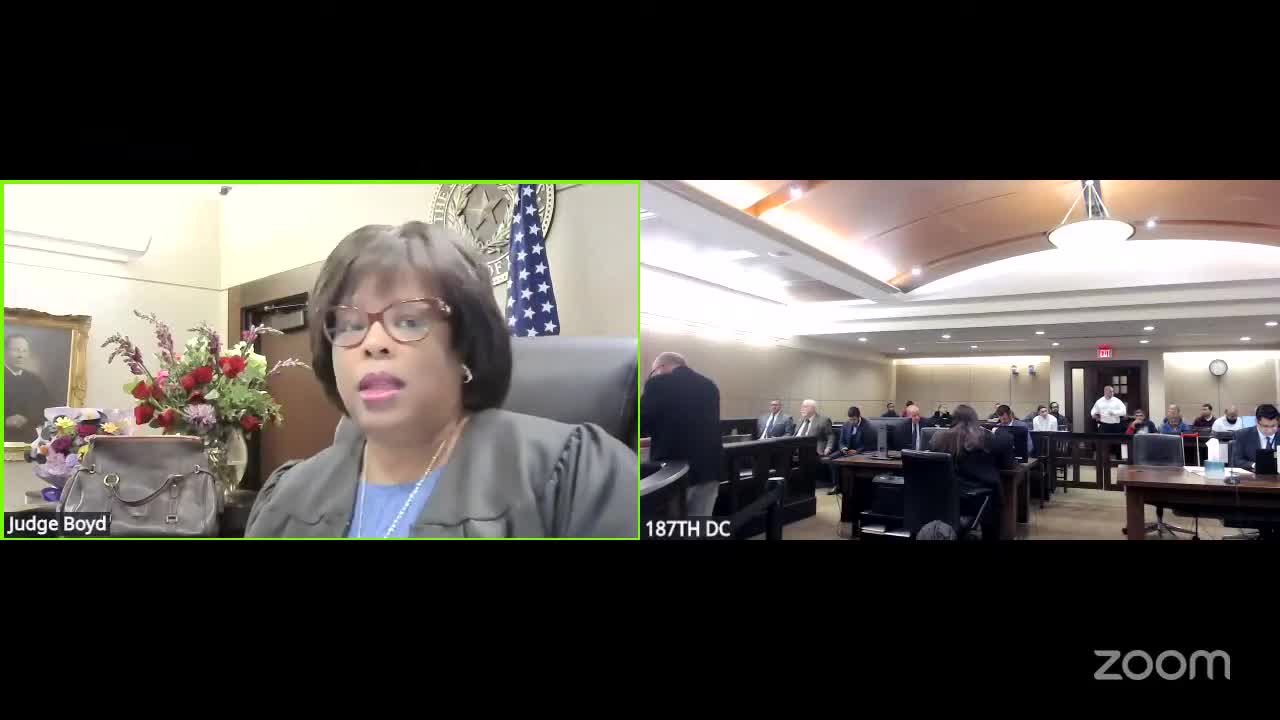
Summary
Judge Stephanie Boyd convened the 187th District Court criminal docket at 9:00 a.m. in Bexar County, calling the roll and warning absent defendants that warrants could follow. The morning session proceeded as a routine docket call and discovery check, but produced several final dispositions and deadlines for upcoming plea and jury‑trial dates.
Judge Stephanie Boyd convened the 187th District Court criminal docket at 9:00 a.m. in Bexar County, calling the roll and warning absent defendants that warrants could follow. The morning session proceeded as a routine docket call and discovery check, but produced several final dispositions and deadlines for upcoming plea and jury-trial dates.
The court ordered remand without bond for a defendant who failed to appear on the docket. "The defendant has not answered docket or made an appearance," Boyd said before ordering the defendant remanded without bond and noting the court could reconsider if the person appears. The court made similar bond-forfeiture orders later in the morning when counsel reported they could not reach clients.
In a contested revocation matter, Daniel Ramos Balderas pleaded true to an alleged violation and the court accepted a plea agreement that adjudicated him guilty. "The court is finding violation of condition number 1 true," Boyd said, then revoked community supervision and sentenced Ramos Balderas to 12 months in a state-jail facility with credit for time served. The judge explained the collateral consequences and confirmed the defendant waived the right to appeal as part of the plea process.
At a sentencing hearing, the court granted deferred adjudication and a detailed probation plan for Brianna Marie Gonzales, who had entered a no‑contest plea to robbery. The court imposed six years' deferred adjudication, intensive outpatient treatment, regular random urinalysis, proof of employment within 45 days, restrictions on certain types of work (no home‑health or with minors), monthly field visits and a restitution/fine structure: a $2,000 restitution amount and a probated fine, plus 200 hours of community-service restitution (100 hours waived upon completion of a GED or trade-school certification). The judge told Gonzales the court expected follow-through on therapy and sobriety and recommended trauma-focused counseling because of the defendant's history in foster care. Defense counsel Todd Lesser urged leniency; the court explained the conditions and issued the order.
The court also accepted a guilty plea and imposed sentence in a separate theft case. Pablo Valdez waived the reading of the indictment, pleaded guilty and the court sentenced him to 12 months in the state-jail facility and a $1,500 fine; the plea included no-contact directives with two named retail businesses. In another high‑profile plea, the court accepted a no‑contest plea from Guillermo Mejia Ortega and sentenced him to 10 years in prison with Chapter 62 registration requirements and long-term restrictions on contact with minors as set out in the plea.
For a probation revocation matter involving Jesus Antonio Santoya, the court found a violation of condition number 21 true. After hearing the state and defense recommendations, the court extended probation for one year, altered conditions to require local ISF followed by ISP (intensive supervision/program placement), and took the defendant into custody to begin the ordered supervision or treatment. Defense counsel Jonathan Watkins and the prosecutor presented the agreement and the court explained the custodial transfer and monitoring plan.
Throughout the morning the court addressed discovery issues in multiple cases (phone extractions and voluminous video files), ordered exchanges of USB/thumb drives where necessary, and set plea-deadline and jury-trial dates — most commonly in the first two weeks of December. The judge repeatedly instructed counsel to confer off docket about outstanding discovery and to tender offers where indicated. The docket recessed at noon so the jurors and staff could prepare for a jury trial resuming at 1:30 p.m.
What happened next: most matters without final disposition were reset for December plea deadlines or quick-turnaround jury-trial settings; the court told parties to return on the listed dates prepared to proceed, and reminded all attendees again to be on time and follow courtroom rules.