Get Full Government Meeting Transcripts, Videos, & Alerts Forever!
Get email alerts on the Jc Park topic
No spam. Unsubscribe anytime.
Cape Coral officials back further design work for JC Park boat slips, flag oyster mitigation and long permitting timeline
Summary
Council heard a 30–35% complete design for JC Park Phase 2 and gave staff direction to refine two floating‑dock options (versions 4 and 5), add a kayak launch, and return with sight‑line measurements and mitigation plans; consultants warned of oyster mitigation requirements and Army Corps permit timelines of 18–24 months or longer.
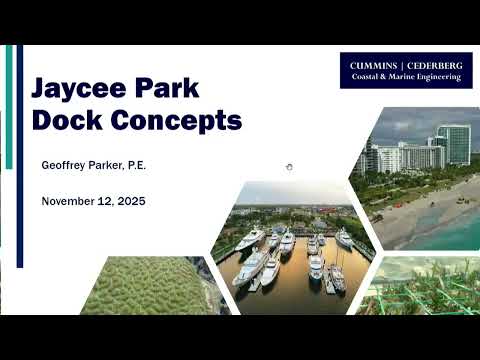
Assistant City Manager Connie (assistant city manager) and marine engineer Jeff Parker of Cummins|Sedibur presented options for Phase 2 of JC Park, recommending a floating‑dock approach to achieve acceptable vessel‑birthing conditions most of the year while minimizing dredge footprint. Parker said the design is about 30–35% complete and that floating docks provide inherent wave‑attenuating properties; his birthing analysis showed moderate (acceptable) conditions for the North dock about 334 days per year and for the South dock about 324 days per year under the proposed configuration. “Floating docks inherently have wave‑attenuating properties,” Parker said. He recommended the split north/south dock layout that would hold about 24 slips total, noting staff trimmed three slips at the north dock to avoid upland sight‑lines but kept the option to restore them.
The presentation flagged new environmental constraints: a recent resource survey found oyster beds at the proposed South dock location. Parker said agencies now require mitigation for impacts to oysters and that the permitting path includes the South Florida Water Management District, the Florida Fish and Wildlife Conservation Commission (FWC) for oyster mitigation, and the U.S. Army Corps of Engineers; he advised council that Corps permitting has recently taken 18–24 months and could take longer. “We found that oysters are indeed in place at the South Dock. We would be impacting them. What that means as far as the permitting mitigation, we don’t know yet,” Parker said.
Council members emphasized resident affordability concerns, sight‑line impacts and maintenance/dredging frequency. Council directed staff to return with precise measurements of the park upland view cone, the dimension tradeoffs between concept 4 and 5 (the three slips in question), and to include a kayak launch or kayak float in the refined design. Assistant City Manager Connie confirmed the dock design and permitting were part of the original design contract and that the city can complete the design and then pursue permitting; she noted construction would be a later decision and that existing landward work does not include marine construction costs.
Next steps: staff will pursue 60% design work and provide the requested sight‑line and kayak‑launch information back to council, produce cost and dredge‑footprint comparisons for the trimmed three‑slip option, and continue coordination with regulatory agencies on oyster mitigation and Army Corps timelines. No construction contract or final funding decision was made at the meeting.