Lifetime Citizen Portal Access — AI Briefings, Alerts & Unlimited Follows
California monitoring group readies plastics pilot and eyes Lancet monitoring submission; tobacco-filter waste debate surfaces
Loading...
Summary
The California Water Quality Monitoring Council'Trash Monitoring Work Group discussed moving the state's plastics monitoring strategy into pilot implementation and considered responding to an international Lancet call for monitoring proposals.
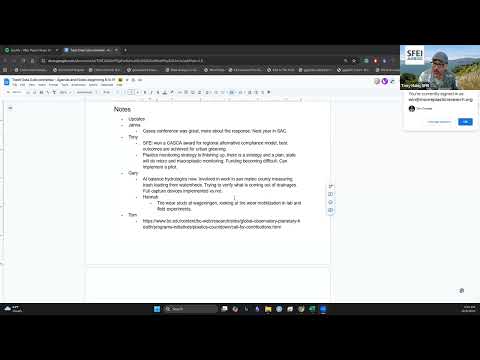
The California Water Quality Monitoring Council'Trash Monitoring Work Group on a regular meeting discussed progress toward implementing a statewide plastics monitoring strategy that the California Ocean Protection Council funded and that is being coordinated with the State Water Board. Tony (SFPI) said, “we're approaching the point of implementation of this strategy,” and invited members to join a pilot effort for both macroplastics and microplastics monitoring.
Why it matters: the strategy maps monitoring needs for plastics that enter receiving waters and could influence permit compliance and research priorities. Tony and others noted the strategy currently has limited discretionary funding for implementation, though potential funding avenues are being explored. He told the group the strategy is moving from planning to a pilot phase and asked interested parties to contact the implementation team for participation.
Dr. Tom Novotny briefed the group on an international opportunity to submit monitoring proposals to a Lancet-affiliated activity. Novotny said “this is an international activity going on, as an invitation, for to provide monitoring indicators on plastics,” and described four working groups (production/emissions; exposures; health impacts; interventions/engagement). The Lancet solicitation seeks proposals as preliminary submissions in January; while the call does not guarantee project funding, Novotny said publication and visibility in The Lancet could attract funders.
The meeting also connected plastics monitoring to related tobacco-product waste action. Novotny reported he was senior author on a report to the World Health Organization about environmental aspects of tobacco and that the WHO Framework Convention on Tobacco Control is considering measures that could include banning sale of filtered cigarettes in some jurisdictions. He described a civil lawsuit in Baltimore that uses systematic trash-wheel sampling of cigarette-filter waste to pursue claims including public nuisance and product-liability theories; Novotny said the case has assembled expert evidence that may be used in similar local actions.
Participants discussed policy responses and technical options. Novotny warned that biodegradable filters are not a solution to tobacco pollution and said filters do not protect health, noting that some local jurisdictions (for example, Santa Cruz) have moved toward banning sale of filtered cigarettes. The group also raised monitoring concerns related to newer nicotine products (synthetic nicotine pouches) that add toxicants to the waste stream.
Next steps: organizers encouraged the work group to consider coordinating a Lancet submission drawing on California pilots and to consolidate monitoring proposals for broader visibility. Tony and Novotny asked interested members to communicate through the work group to support coordinated submissions and follow up on the pilot implementation timeline and funding.