
Budget committee backs 4% inflation escalator for neighborhood parks, sending measure to full council
Get AI-powered insights, summaries, and transcripts
Subscribe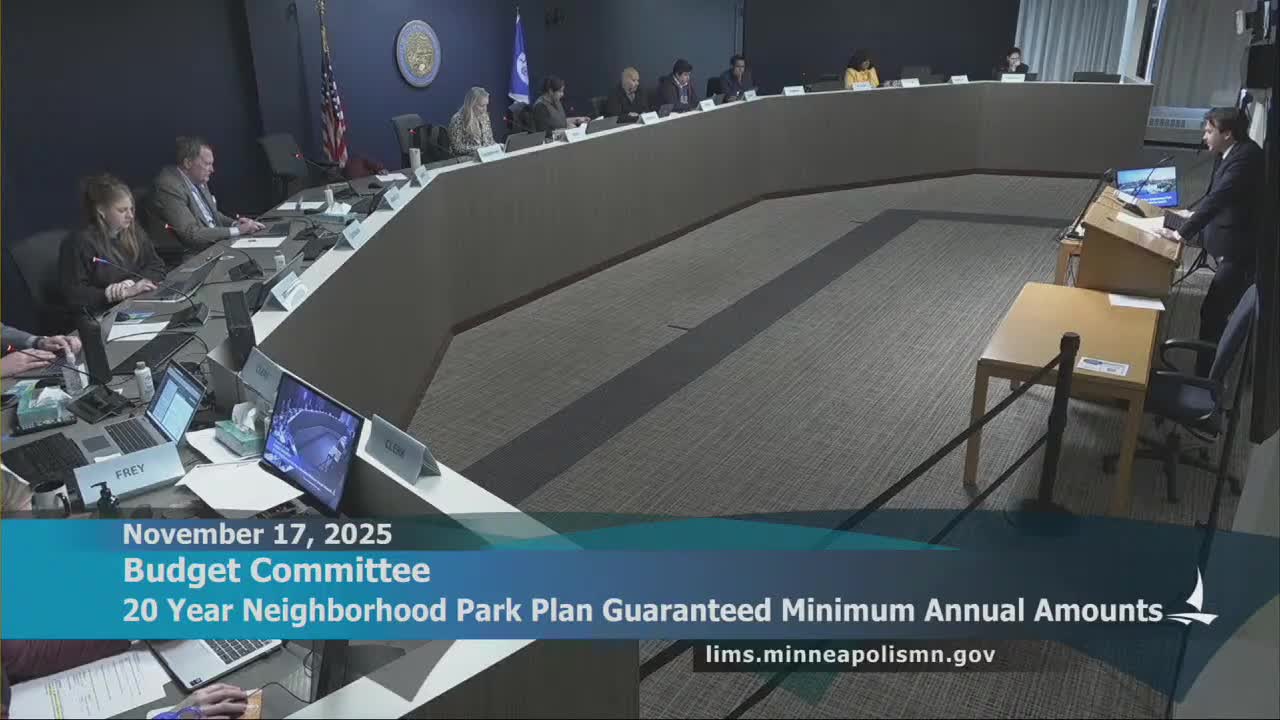
Summary
The Minneapolis City Budget Committee approved a resolution to adopt a 4% annual inflation adjustment for guaranteed minimum neighborhood park funding from 2027–2031, projecting annual funding to rise from $13.1 million in 2026 to about $15.9 million by 2031; the measure requires concurrent Park Board action and full council adoption on Nov. 20.
The Minneapolis City Budget Committee on Nov. 17 approved a resolution proposing a 4% annual inflationary adjustment to the parks infrastructure component of the 20-year neighborhood park plan, sending the item to the full City Council for final adoption on Nov. 20.
Liam O’Brien, senior budget analyst with the Finance and Property Services Department, told the committee the ordinance (chapter 16, article 14 of the municipal code) set guaranteed minimum annual funding for neighborhood parks in 2016 and requires the city and the Minneapolis Park and Recreation Board to review and adjust amounts every five years. "This inflation increase is not intended to increase the number of projects the Park Board will complete, but to account for construction inflation costs associated with planned projects and to ensure the effectiveness of the funding that we allocate," O’Brien said.
Under the proposal, the 3% escalator that applied for 2022–2026 — which raised the baseline from $10,500,000 (2016–2020) to $13,100,000 by 2026 — would be followed by a 4% compounded increase for 2027–2031. O’Brien projected that, at 4% compounded annually, the $13,100,000 budget for 2026 would grow to approximately $15,900,000 by 2031. He said the city plans to cover the increase through capital bonding, and stressed the resolution "does not program or appropriate funding at this time."
O’Brien described the technical basis for the change: the Park Board submitted a letter from Rockwise Strategies recommending a 4% annual cost escalator based on several published construction cost indices, and the budget office performed an independent comparison of national and Twin Cities nonresidential construction cost indices. The office found national nonresidential construction costs rose 3.8% from 2023–2025 and Twin Cities costs rose 3.4% over the same period; staff concluded that, given factors such as tariffs and construction goods pressures, a 4% annual escalator is reasonable.
Council member Vito thanked staff and described the adjustment as "a routine thing" focused on inflation and the city’s relationship with the Park Board. With no further discussion, Chair Ayesha Chugtai moved approval and the committee approved the resolution by voice vote; the chair declared, "The ayes have it and that motion carries." The committee did not read individual vote tallies during the meeting. The Park and Recreation Board approved a concurrent resolution on Nov. 5, and if the City Council adopts the same wording on Nov. 20, the adjustment would be incorporated into the park capital program beginning in 2027.
Next steps: the committee’s approval forwards the resolution to the full City Council, which is scheduled to consider adoption on Nov. 20. The committee noted that adoption of the resolution itself does not appropriate funds; any bond authorizations or appropriations would follow separate budget and capital processes.