Lifetime Citizen Portal Access — AI Briefings, Alerts & Unlimited Follows
Pontiac ZBA approves vinyl fence in place of required masonry wall at Oakland Fuels site
Loading...
Summary
The Pontiac Zoning Board of Appeals unanimously approved a dimensional variance allowing vinyl fencing instead of a masonry wall at 1144 N. Perry St. (Oakland Fuels), after hearing staff history, the owner’s counsel invoke laches and commissioners debate enforcement timing and aesthetics.
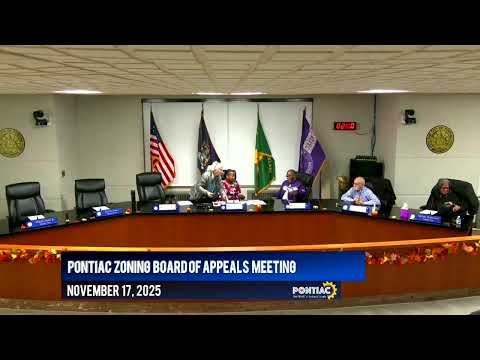
Pontiac’s Zoning Board of Appeals voted unanimously on Nov. 17 to grant a dimensional variance (ZBA25-008) allowing vinyl fencing in place of the masonry wall required at 1144 North Perry Street, a longtime gas station operated by Oakland Fuels.
Planning staff told the board the site has operated as an automobile filling station since 1985 and that the Pontiac Planning Commission’s 1985 site-plan approval included a condition requiring a masonry wall. Staff cited the current ordinance sections that prescribe a type-a (option 1) buffer—Article 2, Chapter 5 §2.509 and Article 4, Chapter 4 §4.405—and said the building and safety division withheld a 2022 re-occupancy certificate pending construction of a masonry wall.
Attorney Andrew Littman, representing the petitioner, asked the board either to overturn an administrative enforcement requiring a masonry wall or, in the alternative, to grant a dimensional variance under §6.407(b). Littman argued the doctrine of laches and detrimental reliance applies because decades passed before enforcement and construction costs have risen substantially, citing Bureau of Labor Statistics / producer price index data that masonry and related materials increased “by 25 to 30%” over the last five years. “Because the city waited decades and is now enforcing this, during a period of elevated construction costs, the petitioner is bearing a huge, additional financial burden,” Littman said.
Jeff Rubin, speaking for Oakland Fuels, said the company has operated multiple Pontiac locations for about 25 years and that the business leased this particular location after the pandemic. Rubin said most compliance correspondence over recent years involved a tenant, and that he was made aware of the masonry requirement less than eight months ago. “We have no problem maintaining it or even putting in a brand-new vinyl fence,” Rubin told the board.
Commissioners pressed staff and the applicant on file history. Planning staff said records do not show when the current vinyl fence was installed and that there is no clear evidence in the file that the masonry wall required in the 1985 approval was ever constructed, despite a surety bond appearing in original documents. Staff also noted that under the current zoning ordinance the Planning Commission—not the planning administrator—has the authority to approve a different fence material in some cases, and that code-required landscaping (an option-1 buffer requires two deciduous trees per 100 linear feet) would be difficult where the curb is nearly flush with the fence.
Several commissioners said they preferred a masonry wall on principle but acknowledged the long delay in enforcement and legal arguments about detrimental reliance. Board members emphasized that, if approved, the applicant must ensure the fence is repaired, maintained and otherwise complies with code provisions applicable to the buffer.
Board member May moved to approve a dimensional variance to allow vinyl fencing in lieu of the masonry wall at 1144 North Perry Street; on a roll-call vote all present voted yes. A secondary motion clarifying that the buffer material may be vinyl fencing also passed. Chair Bevacqua closed by reminding the applicant to comply with all other applicable requirements.
The board’s action grants the requested relief for ZBA25-008. The record indicates staff provided analysis but offered no recommendation; the Planning Commission retains authority over final material approvals if the matter returns under current code procedures.
What’s next: the variance relieves Oakland Fuels from the immediate masonry-wall requirement at the property address specified; the decision is a local, discretionary land-use approval and any future enforcement or appeals would follow Pontiac’s administrative processes.