Lifetime Citizen Portal Access — AI Briefings, Alerts & Unlimited Follows
BZA approves parking relief but denies variance for Hobart Place conversion, blocking legalization of third unit
Loading...
Summary
The Board of Zoning Adjustment approved a parking special exception for 725 Hobart Place NW but denied an area variance from the 900‑square‑foot per‑unit rule and, consequently, the conversion to a three‑unit apartment. Board members cited court precedent on 'self‑creation' and the applicant's failure to demonstrate a property‑based practical difficulty.
WASHINGTON — The District of Columbia Board of Zoning Adjustment on Dec. 2025 approved a parking special exception for a proposed conversion at 725 Hobart Place NW, but rejected the area variance that the applicant said was necessary to legalize a third dwelling unit.
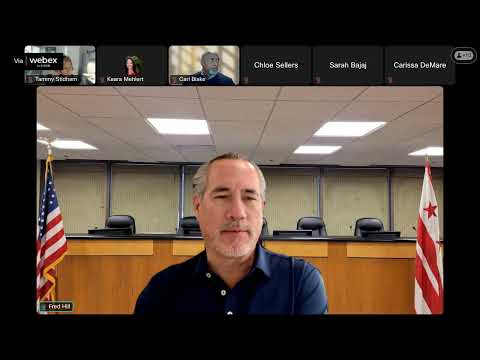
Chairman Fred Hill moved to approve the parking special exception under Subtitle C §703.2; the motion, seconded by Vice Chair Carl Blake, passed with the board recording the vote and identifying Chairman Hill, Vice Chair Blake and Commissioner Anthony Hood as voting yes. Later the board voted to deny the area variance from Subtitle U §320.2(c) (the 900‑square‑foot per‑unit rule) and to deny the conversion special exception that depended on that variance.
Why it mattered: The property is an existing three‑story row house configured as three separate units but lacks a certificate of occupancy for the third unit. That raised a central legal question: whether the board could base a variance on an unlawful, preexisting unit when the owner purchased the property while it already contained the unpermitted use.
Board member Carl Blake, who led the deliberation, grounded his denial in D.C. Court of Appeals precedent applying the ‘self‑creation’ doctrine. Blake summarized his view of the record and case law and told the board: “So these version for these reasons, I will vote to deny the area variance and constantly the conversion relief.” He agreed with Office of Planning conclusions on parking but concluded that the applicant had not met the first two prongs of the area variance test — exceptional condition and property‑based practical difficulty — because the unlawfully created third unit could not be treated as an exceptional condition.
Chairman Hill echoed Blake’s analysis and said the record did not demonstrate that reconfiguring the building to two lawful units would be infeasible. Commissioner Hood added that policy changes by OP do not substitute for formal rulemaking and that any policy shift should come to the Zoning Commission.
The board’s recorded outcome: staff recorded the parking special exception as approved and the area variance and dependent conversion special exception as denied. The transcript records the staff tally repeatedly as “3 to 0 to 2”; the three named board members were recorded as voting yes on the motions (Chairman Hill, Vice Chair Blake and Commissioner Hood); other board members were not recorded as voting on those motions in the transcript.
What happens next: Because the variance was denied, the conversion cannot be approved; the applicant may consider administrative or legal options outside the BZA process. The board retained the record for that application and noted the applicant may submit follow‑up materials consistent with the board's guidance.
Direct transcript sources: Deliberations and votes were discussed and recorded during the board’s meeting on the matter of application 21307.