Get Full Government Meeting Transcripts, Videos, & Alerts Forever!
Get email alerts on the Housing Development topic
No spam. Unsubscribe anytime.
Residents and students press council to block or scale back LV Collective student housing and to protect Clark Court parking
Summary
Multiple speakers during the public‑comment period urged Charlottesville City Council to halt or substantially alter the LV Collective student‑housing proposal on West Main Street, arguing the project will displace residents, repeat historic injustices near public housing, and that the Clark Court vacation for a private drive misrepresents replacement parking promises.
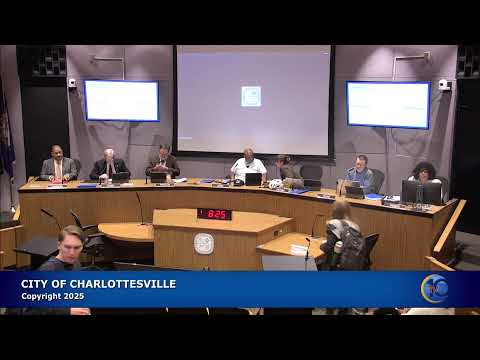
Multiple residents, housing advocates and UVA students used the public‑comment period at the Nov. 17 Charlottesville City Council meeting to press the council to reconsider large student housing proposals on West Main Street and to halt a street vacation that would convert public parking on Clark Court.
Terry Tyree, a West Haven resident and intern with FAR in Virginia organizing, said the LV Collective plan — currently proposed as an eight‑ to 11‑story luxury student building adjacent to West Haven public housing — would “repeat historic injustices” tied to the Vinegar Hill displacement and urged the council to “demand significant reductions in height, not just 3 stories,” to restore discretionary review and to prioritize deeply affordable housing.
Aylin Dutt, a UVA student and member of Friends of FAR, challenged council members’ use of out‑of‑context national data to justify the development. She cited recent planning research and said that in university towns newly built student housing often does not relieve housing pressures for long‑term residents, and warned that the LV Collective would “serve as a reminder and a permanent symbol in the community of the council’s prioritization of profits and students over the local community.”
A representative of the Frye Spring Neighborhood Association asked council to deny a pending application to vacate Clark Court to support the Jefferson Scholars Program, saying the Jefferson Scholars’ presentation overstated a working relationship with nearby businesses that would compensate for lost public parking. The speaker told the council the neighborhood association had “no institutional knowledge” of the 16‑year dialogue the applicants claimed and asked that, if the council proceeds, each public parking space removed by the vacation be replaced.
Other residents echoed concerns about scale, community engagement and displacement. Joy Johnson, chair of FAR, urged zoning changes and better protections for low‑income residents of color. Sofia Marrero of the Public Housing Association of Residents invoked Vinegar Hill’s history as a reason to demand lower heights and stronger community control of design. Rachel Mulvaney of UVA’s Friends of FAR asked the council to note the large group in the chamber organizing against the project.
Council did not take final action on the LV Collective proposal during the meeting. Several speakers asked the city to make decisions more transparent, to restore discretionary review where appropriate and to require clear replacement of any public assets (parking or other) surrendered for private development.