Get Full Government Meeting Transcripts, Videos, & Alerts Forever!
Get email alerts on the Noise Ordinance topic
No spam. Unsubscribe anytime.
Delray Beach advances objective noise ordinance, defers entertainment-district expansion
Summary
City staff presented a draft that shifts Delray Beach from a subjective 'plainly audible' rule to objective decibel limits measured by calibrated sound meters, proposes training and phased enforcement starting after a warning period, and prompted debate over lawn-equipment hours and entertainment-district expansion; commissioners asked for more community engagement before any map changes.
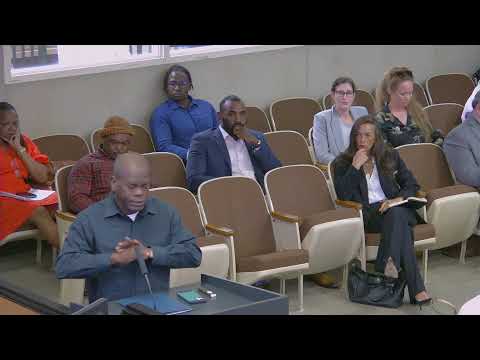
Lynn Jellan of the City Attorney’s Office presented the proposed noise-ordinance update at the Nov. 18 Delray Beach City Commission workshop, describing a multi-year effort that used consultant sound studies and citywide meter readings to set objective decibel limits for active and quiet hours.
The draft replaces a largely subjective standard with a decibel-based, measurable approach and introduces a new map of the entertainment district. Jellan said staff expects to seek adoption in January 2026, train enforcement personnel in January–February, and begin full enforcement around March 1. "We're looking at adoption in early 20 26 in January... probably around March 1 is when full enforcement will begin, ideally," she said.
Why it matters: Commissioners and staff said the objective standard aims to create consistency in enforcement and reduce legal risk from uneven application. The proposal includes detailed measurement procedures — 30-second sound-meter readings, ambient-noise adjustments, and a wind threshold (meters not used when wind exceeds 12 mph) — and requires calibration and training for officers.
Key elements: The draft keeps existing entertainment-district hours in substance (active hours through 1:00 a.m. in the entertainment district) but clarifies definitions for active and quiet hours in other districts (active 7:00 a.m.–10:00 p.m., quiet 10:01 p.m.–6:59 a.m.). It lists exempt activities (special events with permits, unamplified human voice, motor vehicles compliant with Florida Statute ch. 316, certain emergency uses) alongside prohibited activities (unreasonable raised voices within city limits, prolonged animal noise, amplified devices attached to vehicles).
Enforcement, penalties and conditional uses: Staff described a progressive enforcement model: first encounter yields a warning and an immediate compliance opportunity; civil fines would then escalate ($250 for the first citation, $500 for a second, $1,000–$5,000 for repeat violations and up to $15,000 for particularly egregious or irreversible harms). The draft also allows noise violations to be admitted as evidence in conditional-use revocation proceedings.
Debate highlights: Commissioners pressed staff on practical enforcement questions — how officers will catch transient vehicle noise, whether code staff can effectuate traffic stops, and whether to ban gas-powered leaf blowers outright or simply restrict their hours. Staff said motor-vehicle enforcement falls to the Police Department and that code officers cannot pull over vehicles; civil citations are possible but require proper witnessing.
On landscapers, commissioners expressed concern about the cost burden of forcing conversion to electric equipment and recommended phased or compromise hours. Several commissioners suggested weekday hours of 8 a.m.–6 p.m., with shorter windows on weekends (examples discussed included 8–5 Saturday, 8–4 Sunday) during transition. The commission also agreed to reduce the required continuous barking time for an animal-noise complaint from 20 to 10 minutes.
Next steps: Staff will return with refined language and implementation details. Commissioners did not adopt expansion of the entertainment district at this meeting; several members favored using conditional-use approvals to allow extended hours on a case-by-case basis rather than immediate automatic expansion.
The workshop item concluded with staff planning a follow-up in December and formal readings to come.