Lifetime Citizen Portal Access — AI Briefings, Alerts & Unlimited Follows
Resilient Florida staff report program progress, funding demand and implementation challenges
Loading...
Summary
Chief Resilience Officer Eddie Bouza told the subcommittee Resilient Florida has funded planning and implementation grants, completed a statewide assessment (May 2023, final July 2024), and reported $420 million in appropriations to date with broad demand for implementation funding; staff cited permitting delays and staffing needs as challenges.
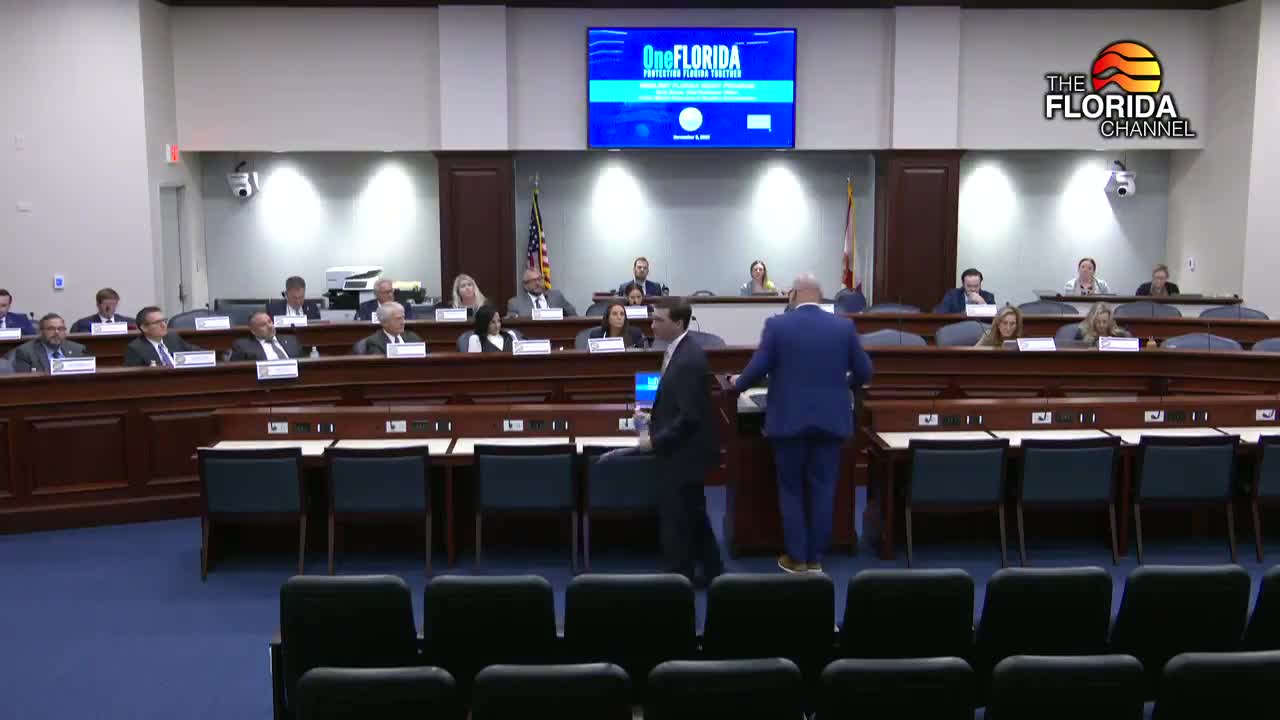
Eddie Bouza, Florida’s chief resilience officer and lead for the Resilient Florida program, briefed the Natural Resources and Disaster Subcommittee on the program’s first years, describing planning grants, a statewide critical-asset assessment and implementation projects funded by the program.
Bouza said Resilient Florida was created in 2021 and that vulnerability assessments (VAs) are required for any county or municipality applying for implementation funding; he said that by 2026 all 67 counties and more than 95% of municipalities are expected to have performed VAs or be included in county studies.
The chief resilience officer described a statewide assessment completed in May 2023 with a final assessment in July 2024 that combined roughly 60 datasets into a catalog of more than 3,000,000 data points identifying critical assets and vulnerability scenarios (2040, 2070 using Florida Flood Hub and NOAA projections). Eligibility for many Resilient Florida implementation grants now requires local assessment results or inclusion in the statewide assessment showing vulnerability.
Bouza outlined project categories and examples: stormwater-capacity and nature-based solutions, adaptation of critical community infrastructure, transportation and evacuation routes, gray and green flood-control approaches, and retrofits of emergency facilities. He highlighted Founders Park Breakwater (Islamorada) — about $1,900,000 in DEP funding — and a Palm Beach County lift-station elevation project funded at roughly $750,000.
Program metrics cited by Bouza included roughly 12,500 Olympic-size pools of stormwater storage (about 8,000,000,000 gallons), about 87 miles of infrastructure improved, 13,000 acres restored or revegetated, ~60 miles of critical roadway protected, and about 165 miles of coastal protection. Bouza acknowledged some projects started slower than expected and said the program had to expand grant-management capacity and consider ways to help grantees resolve permitting and federal-state-local funding stacks.
On funding demand, Bouza said planning grant requests this year totaled about $35,000,000 with $20,000,000 appropriated; implementation requests exceeded $1,000,000,000 and were trimmed to roughly $700–800,000,000 after eligibility review. He summarized total appropriations to date as $420,000,000 (including about $80,000,000 for planning) and reported an earlier total of about $1,600,000,000 for implementation appropriations across cycles as context for program scale.
Committee members probed data and overlap with other agencies. Representative Gentry asked whether figures include projects south of Lake Okeechobee and whether South Florida Water Management District metrics are counted; Bouza said Resilient Florida’s figures reflect grants managed by the program and do not systematically track South Florida Water Management District metrics, though overlap is possible. Representative Benarich asked whether permitting and bureaucratic hurdles caused delays; Bouza said quarterly reports do not itemize causes but that permitting and aligning multiple funding sources likely contributed and offered to follow up with options to streamline processes.
Bouza said Resilient Florida uses scoring criteria (statute and rule) rather than prescriptive design standards; projects that exceed minimum requirements (for example, elevation above base flood elevation) receive additional scoring points, but the program does not impose one-size-fits-all prescriptive elevation or design mandates.
The chair closed the meeting after the presentation and discussion. Representative Jim Mooney moved to rise and the committee adjourned without objection.