Get Full Government Meeting Transcripts, Videos, & Alerts Forever!
Get email alerts on the Comprehensive Plan Update topic
No spam. Unsubscribe anytime.
Maricopa County presents near-final comprehensive plan draft, opens 60-day public review in January
Summary
County staff and consultant Michael Baker International briefed the Planning and Zoning Commission committee on a near-final comprehensive plan draft, highlighted public outreach that produced more than 2,400 surveys and other engagement metrics, and said a 60-day public review will begin in January with commission consideration expected in spring.
Maricopa County planning staff on Nov. 20 updated the Planning and Zoning Commission’s zoning/infrastructure committee on a near-final comprehensive plan draft and detailed extensive public outreach ahead of a 60-day public review scheduled to begin in January.
Adam Cannon of Maricopa County Planning and Development summarized the outreach and said the draft—organized around required elements such as land use, transportation and water—reflects public priorities including safety, protection of natural and rural landscapes, expanded recreational opportunities and economic development. "We had 2,407 completed surveys," Cannon said, adding that mapping activities, idea-wall comments and website visits informed the draft.
Why this matters: the comprehensive plan frames county-level policy for growth, land use and infrastructure for the coming decade and will guide how commissioners evaluate future zone-change and development recommendations.
Details from the briefing
Cannon said the project used multiple outreach phases and a technical advisory committee and reported the following engagement figures: 13 public meetings across the five supervisor districts in seven locations, three countywide virtual meetings, 154 mapping responses, 2,407 completed surveys, 577 idea wall posts/comments, more than 9,000 website visits and roughly 6,474 unique visitors, plus over 3,000 participants in virtual engagement activities.
Staff said public input coalesced around six priority areas: emergency-response and public-safety coverage; preserving natural and rural landscapes; expanding access to recreational lands and trails; encouraging higher-quality development; protecting the regional water supply; and supporting economic development, especially in health-care and technology industries.
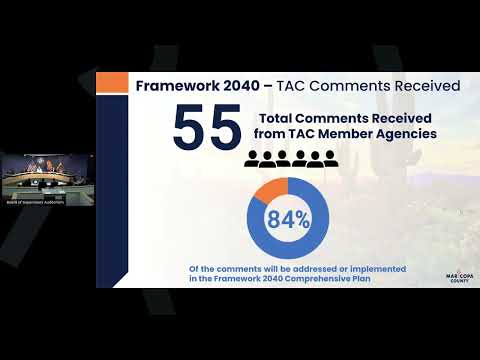
Cannon noted that most goals and policies were developed from public and stakeholder feedback and were crafted "in line with state statute." He told the committee that 55 comments from member agencies had been received and that "we were able to address or implement at least 84% of those comments into the comprehensive plan draft document." He said the draft organizes goals under required plan elements—including a land-use element that looks at anticipated growth over the next 10 years.
On water, Cannon cautioned that the county’s ability to set water supply or conservation policy is limited. "Maricopa County has little influence on water supply or conservation," he said, adding that such policy is typically controlled at the state level and that the county is not itself a water provider.
Consultant role, Framework 2040
Michael Baker International consultant Matt Kliesico described a "Framework 2040" model meant to clarify the interface between urban and rural areas and to provide a methodical process for determining where urban services should be required for development. "This tool will help us ensure that there's urban services for urban development," Kliesico said, adding that the framework converts existing policies into a clearer decision flow for the public.
Next steps and timeline
Cannon said the county will release a 60-day public review draft in January, kick the review off with a grand virtual meeting, possibly hold an additional agency meeting during that period, and then return the plan to the commission for final consideration in spring.
The committee offered brief thanks and no changes were made during the session. No motions or formal votes were recorded at the Nov. 20 meeting; the committee adjourned following the presentation.