
Sumner County forms ad hoc committee to study volunteer fire department funding; detailed funding talk tabled until January
Get AI-powered insights, summaries, and transcripts
Subscribe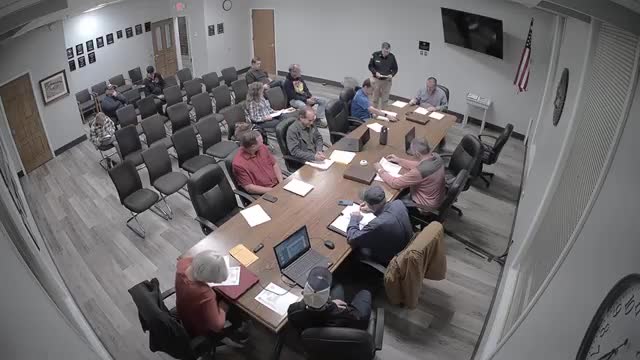
Summary
Sumner County commissioners, volunteer chiefs and residents met to launch an ad hoc committee to study long‑term funding and organizational options for nine volunteer fire departments (13 stations). The committee set regular meetings, elected a vice chair and voted to table funding proposals until January while collecting budgets, asset lists and call‑volume data.
Sumner County commissioners, volunteer fire chiefs and residents met at an ad hoc committee meeting to begin studying long‑term funding and organizational options for volunteer fire protection in the county’s unincorporated areas. The group adopted a regular meeting schedule, elected a vice chairman and voted to table detailed funding proposals until January to allow staff and chiefs time to gather budgets, asset inventories and call‑volume data.
The committee was created after earlier recommendations — which proposed using the CTAS funding formula and contracting with volunteer departments — stalled in legislative and budget committees, a presenter said. “This came about from discussions by commissioners and the budget committee,” an unidentified presenter said, summarizing prior committee work.
During public comment, resident Laura Bagert urged use of state financial filings to understand department finances and compliance. “Only 15% of the fire departments have been compliant with filing that report,” Bagert said, referring to reports on the Tennessee Comptroller of the Treasury’s website. She said reviewing five years of filings can show revenues and expenditures and help identify best practices.
Several committee members echoed the need for baseline data before choosing a funding mechanism. “We’ve got to put together a plan including best practice,” said Curtis Williams, who represents a volunteer fire district; he urged the group to use grant-writing resources and county staff to help departments that have not pursued available state grant money. County Commissioner David Klein said the committee must “get past the kick in the can down the road” and find a permanent solution.
On governance and logistics, the committee filled leadership roles and set its schedule. After nominations, the committee elected Mr. Shoemaker as vice chairman in a vote reported as “4 to 3.” The group also agreed to meet monthly on the second Tuesday at 5:30 p.m.; the next meeting was set for December 9. Chair and staff assigned homework: circulate the CTAS report and collect department budgets, apparatus and membership counts, grant histories, ISO coverage data and call‑volume analytics (ECC/FireText) to produce a shared baseline for future funding discussion.
Members recommended technical references to guide the analysis, notably NFPA 1720 and CTAS materials, and asked staff to produce large‑format GIS maps showing five‑mile station coverage so the committee could visualize gaps. The chiefs plan to designate Chief Edgerton as a point of contact to collate data from the nine volunteer departments and 13 stations serving county areas outside municipal limits.
The committee’s formal action on funding was procedural: a motion to table the funding‑ideas item until the January meeting passed after members agreed the requested data would inform any proposal. The committee will reconvene after the December circulation of reports and data to consider specific funding models — including continued nonprofit volunteers, a merged or partially paid county service, subscription models, or other options — once the baseline is complete.
Next steps: staff will circulate the CTAS report and collected budgets; chiefs will provide inventories and needs; GIS will prepare coverage maps; and the committee will review the assembled materials before the January funding discussion.