
Bountiful council reviews draft 'Bountiful by Design,' signals changes on neighborhood nodes and transportation
Get AI-powered insights, summaries, and transcripts
Subscribe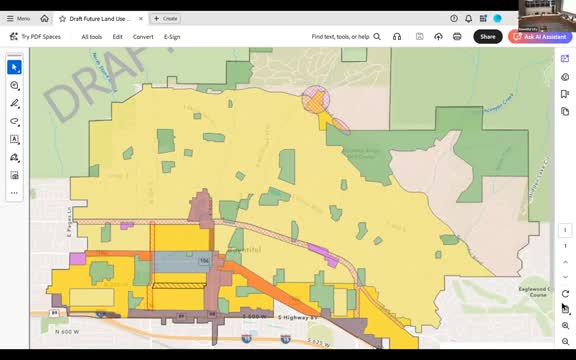
Summary
The council reviewed a detailed draft of the city’s General Plan after a multi‑year process, instructed staff to remove or modify some neighborhood‑center overlays, asked for an Orchard Drive corridor study and directed planners to add active‑transportation language. Adoption will not change zoning immediately; code and map updates will follow.
Bountiful City Council spent the Nov. 25 meeting conducting a line‑by‑line review of the draft General Plan titled “Bountiful by Design,” with city planner Francisco Astorga summarizing three years of technical analysis, outreach and Planning Commission redlines.
The plan, staff and the Planning Commission position it as a policy roadmap rather than an automatic zoning change: Astorga read a paragraph stressing that adoption alone would not trigger immediate rezoning and that implementation requires phased code and map updates subject to additional public processes.
Council members offered targeted edits. Several members asked staff to remove proposed neighborhood‑center overlays at the Bountiful Boulevard/1800 South intersection and near the golf course, citing steep slopes and flood‑control basins. On Orchard Drive’s “bend” by Bolton Elementary, the council directed staff to downgrade the proposed overlay from “neighborhood center” to a lower‑intensity “neighborhood mix” designation (defined in the draft as small‑scale, low‑intensity mixed uses) because of visibility and safety concerns; the Bend was bounded in the discussion roughly from 2550 South to 200 West. The council also asked staff to pair any Orchard Drive changes with a dedicated corridor study to evaluate safety, circulation and multimodal solutions.
Councilmembers supported adding clearer language recognizing active transportation (pedestrians, bicyclists and other non‑motorized users) to the transportation framework and requested the plan call out the regional South Davis Greenway work as a complementary action. Planning staff agreed to add the term and tie the greenway work to the plan’s implementation actions.
On land‑use detail, councilmembers debated whether several small areas should remain single‑family or allow limited flexibility. The mayor and multiple councilmembers stressed the plan should avoid “freezing” neighborhoods while retaining tools for modest, context‑sensitive infill (for example, cottage courts or ADUs) in mixed‑use designations. For the hospital area, the council asked staff to clarify that the hospital neighborhood would favor office and medical support services and exclude large‑format retail and high‑density residential that would be incompatible with adjacent single‑family areas.
Astorga and staff recorded council direction point by point; council members agreed to continue the item to the Dec. 9 meeting so staff can present a revised draft. The mayor and staff repeatedly emphasized that zoning and development code changes would be necessary to implement the plan’s place types and that those steps will require separate hearings and votes.