
Michigan City water superintendent outlines roughly $50.5 million bond plan and three‑year rate increase
Get AI-powered insights, summaries, and transcripts
Subscribe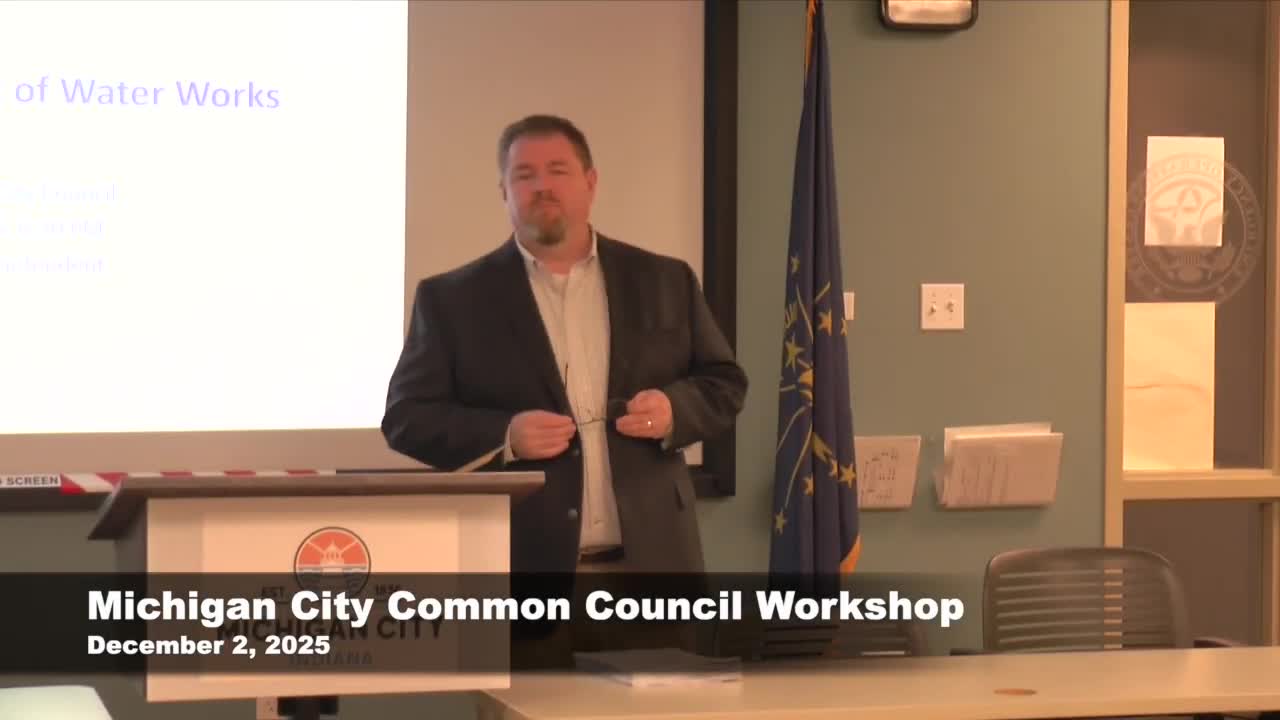
Summary
At a Dec. 2 Michigan City Common Council workshop, Water Works Superintendent Chris Johnson presented a two‑phase $50.5 million bonding plan to replace aging mains, add a booster station and fund treatment and distribution projects; he said the utility will seek Indiana Utility Regulatory Commission approval and proposed phased residential increases totaling $16.11 over 2027–29.
Chris Johnson, superintendent of the Michigan City Department of Water Works, told the Common Council at a Dec. 2 workshop that the utility will seek approval for a roughly $50.5 million, two‑phase bond package to pay for treatment, distribution and equipment projects and to replace aging water mains.
Johnson said the utility has not raised rates since 2015 and that inflation and rising input costs — including chemicals, power and construction materials — have outpaced revenue gains. "We have projects ... several million dollars worth of projects that were necessary," he said, adding later, "I hate to say it, but we have to do it." He described a capital plan developed with Westler Engineering that lists projects through 2044.
Why it matters: the water system includes about a little over 240 miles of mains with roughly 44.7 miles at least 100 years old, Johnson said, and the utility experiences recurring main breaks in older neighborhoods. The proposed work includes targeted main replacements, an east‑side booster station to address low pressure in outlying areas, some water‑quality projects and routine capital such as meters and hydrants.
Plan and cost: Johnson presented phased financing and cost estimates. The first phase would be sold around late 2026 or early 2027 for about $35 million; a second phase in 2029 would be roughly $15.6 million, for a combined package of about $50.5 million. Johnson said the utility's attorneys recommended including a contingency cap; the presentation listed a maximum contingency figure of $60.5 million as a not‑to‑exceed amount to avoid refiling if project costs change. Non‑construction costs for design and permitting were described as just under $7 million.
Rate impact and timeline: Johnson outlined a phased rate schedule for a typical residential bill (based on 5.35 hundred cubic feet): the current average of $23.09 would rise by $9.21 in 2027 to $32.30, increase by $3.28 in 2028 and by $3.62 in 2029, a cumulative $16.11 increase that would place the typical bill near $39.20 by 2029. He cited a Baker Tilly comparison showing Michigan City rates would remain below the state and Northwest Indiana averages even after the increases. Johnson emphasized the proposal must pass regulatory review; the Indiana Utility Regulatory Commission and the Office of Utility Consumer Counselor will review the filing, and he estimated the IURC process could take about nine to 12 months.
Public questions and priorities: During questions from council members and attendees, Johnson said many rental units are individually metered so tenants often pay water bills directly but acknowledged landlords could pass some costs through. He said prioritization for pipe replacement will focus first on mains with frequent breaks and areas with customer complaints. Responding to a resident who said, "I still have rust coming into the house," Johnson said customers should call the utility so crews can investigate, perform flushing and prioritize that area if needed.
Funding alternatives and SRF: Council members asked whether State Revolving Fund (SRF) loan programs could reduce borrowing costs. Johnson said SRF eligibility and scoring can be complex; because Michigan City’s current rates are comparatively low, SRF administrators may require rate changes to qualify, potentially creating a tradeoff rather than an immediate benefit. He said municipal bond rates the utility expects are competitive with SRF in many cases.
Data center question: Johnson said the proposed projects do not primarily benefit the data center under construction; only one project is near the site and it is intended to improve pressure for residential and commercial customers in that area. He told the workshop he did not expect the data center to materially change annual water revenues.
Next steps: Johnson said the same information will be part of the formal case filed with the Indiana Utility Regulatory Commission and the Water Works board and council will continue to vet the ordinance and financing. The council’s regular session later that night was identified as the venue where the superintendent would present the bond ordinance for consideration.
(Reporting note: project cost figures were presented in the public workshop materials and discussed on the record; transcript figures contained formatting irregularities for one construction line item, and totals in this article follow the phase and total figures presented by the superintendent during the meeting.)