
Lake Oswego planning commission votes 4–1 to forward revised home-occupation rules, strikes hazardous-material and other proposed limits
Get AI-powered insights, summaries, and transcripts
Subscribe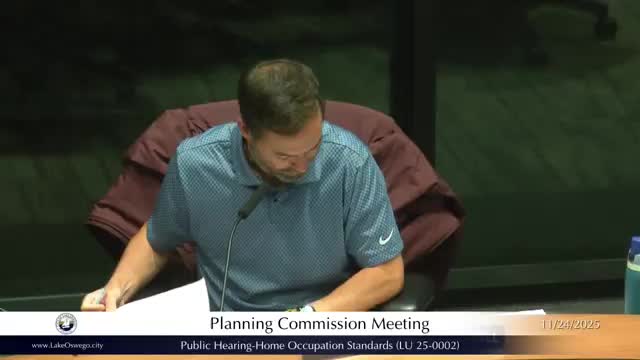
Summary
After public testimony from small-business owners and residents, the Lake Oswego Planning Commission voted 4–1 to forward staff’s home-occupation code amendments to city council while striking a proposed hazardous-material prohibition and several other provisions and making urban agriculture a conditional use.
The Lake Oswego Planning Commission voted 4–1 on Nov. 24 to forward staff-recommended amendments to the city’s home-occupation rules to city council, but not without changes. Commissioners approved a motion to send the package to council while removing the proposed city-level hazardous-substances ban and several other discrete restrictions, and to treat the proposed urban-agriculture use as a conditional use subject to site-specific limits.
Staff coordinator Michael McNamee presented the proposed amendments as an effort to replace a vague standard that a home occupation “cannot alter the residential character of the neighborhood” with clearer, measurable standards. The proposal would classify home occupations into three types — A (no customers onsite), B (customers allowed), and C (short-term rentals) — and add rules including a reference to the city’s nuisance code, a limit on off-site marked commercial vehicles, and numeric caps on customers for some uses. McNamee told the commission the staff recommendation was to forward the amendments to the City Council for its review and adoption.
Why it matters: Commissioners and local business owners framed the debate as a trade-off between enforceability and economic impact. Code-enforcement staff said objective numbers make enforcement and court presentations easier, while several commissioners and multiple public speakers warned that arbitrary limits could disrupt longstanding small businesses and entrepreneurs who operate from home.
Public testimony brought practical concerns into the record. Diane Cassidy, a Lake Oswego resident and neighborhood association board member, said she learned about a separate zone-change proposal for Cruise Way late and warned that large-scale changes should not be treated as minor map amendments; she also said that numerical caps and other limits could tear apart long-term expectations set by the comprehensive plan. Sam Hall, who operates two registered home businesses, told commissioners that the survey outreach missed many operational details and warned that rules such as a limit of one visible company vehicle within 300 feet or tight client caps could be easily circumvented (for example, with magnets used as temporary markings) or could prevent businesses from scaling.
Commission debate focused on specific items in the staff’s numbered recommendations. Key numeric and program details discussed on the record included:
- Type-B client limits and outdoor activity: staff described two approaches for outdoor, customer-facing activity: Option 1 would allow small instructional classes (e.g., up to six people, two sessions per day, six per week, hours limited to 9 a.m.–7 p.m. and not on Sundays/holidays); Option 2 would ban outdoor activity for home occupations. Commissioners ultimately favored Option 1 in the motion.
- Urban agriculture: staff proposed a new urban-agriculture land use permitted in R-10 and R-15 zones on lots over one acre, with the use limited to 20,000 square feet or 35% of the lot (whichever is smaller), a customer limit proposed at 10, and operations allowed up to 45 days per year. Staff said existing businesses that would be recategorized would be grandfathered from requiring annual home-occupation approval but would still have to comply with new rules. A winery submitted written testimony requesting a higher customer cap (up to 30).
- Hazardous substances: staff proposed limiting hazardous substances to ‘‘consumer quantities’’ and disallowing storage beyond those amounts, tied to ORS references. Commissioners questioned the need for a city-level prohibition given state and fire-department regulation and flagged potential impacts on artisans and businesses who buy wholesale supplies. The commission’s motion struck that provision from the recommendation.
- Commercial vehicles: the draft would limit off-site parking of marked commercial vehicles to one vehicle within 300 feet at a time; staff explained the rule is focused on visibly marked vehicles because unmarked vehicles are difficult to enforce. Commissioners asked for evidence that multiple off-site commercial vehicles are a recurring problem and noted enforcement is complaint-driven.
The motion that passed (moved by a commissioner who identified the package but sought to strike items 3, 5 and 6, adopt Option 1 for outdoor activity, and make urban agriculture a conditional use) was seconded and approved on roll call, 4–1. Chair Mitchell voted no. The clerk announced the commission’s preliminary decision will be finalized in a written order adopted at a forthcoming meeting in December, and the recommendation will go to the City Council for review; staff said a council hearing is tentatively scheduled for Jan. 20, 2026.
What’s next: The Planning Commission will consider written findings at its Dec. 8 meeting before forwarding the record to council. Staff and commissioners discussed whether additional outreach to home-based businesses or a continued hearing would be helpful before council review.
Quotes that capture the record:
"I didn't hear about the Cruise Way proposed zone change until November 5…citizen involvement has been basically penciled out," resident Diane Cassidy said during public comment.
"There's no path for me not to work at home," Sam Hall told commissioners, urging the city to consider pop-up retail, storefront access, and grant navigation as part of broader small-business support.
"We're trying to write this down on paper as opposed to just deferring to folks for subjective interpretation," a staff attorney said when explaining the rationale for clearer standards.
The commission’s substantive edits and the decision to make urban agriculture conditional leave open site-specific determinations (for example, a conditional-use permit could set a client cap tailored to parking and traffic for that property). The written order adopting the commission’s recommendation will state the final, formal recommendation to the City Council.