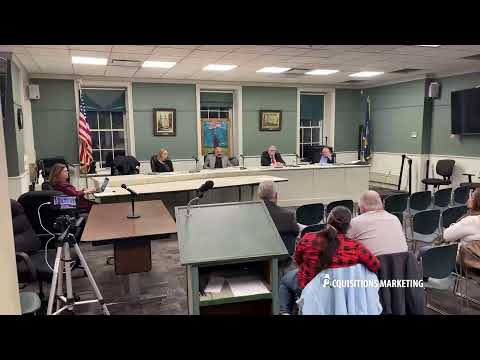
Goshen board weighs intermunicipal water deal with Middletown, considers buying Amy's Kitchen lines; residents press questions on costs and traffic
Loading...
Summary
Board reviewed a proposed nonbinding intermunicipal water‑service agreement with the City of Middletown and discussed taking over water lines from Amy’s Kitchen (three initial parcels in the district), financing (transcript references $6M asset cost and $3M financed over time), operations, capacity allocations, OMH as first customer, and multiple follow‑up items; members deferred final approval pending clarifications.
The Town of Goshen spent the bulk of its Nov. 25 meeting reviewing a proposed intermunicipal water‑service agreement with the City of Middletown that would let Goshen contract for water service and — later — take ownership of water lines currently held by a transportation corporation tied to Amy’s Kitchen.
What the board reviewed: The agreement under discussion covers an initial service area of three parcels (the presenter said the map reflects a water district already approved by state/local regulators for Amy’s Kitchen) and contemplates that additional users may join by paying connection costs. The town would acquire the physical lines to Middletown once a separate transaction with Amy’s Kitchen is finalized; the Middletown agreement itself was described repeatedly in the meeting as a nonbinding, phase‑1 document.
Financing and costs discussed: Multiple speakers cited two headline figures during the discussion: a cited replacement/installation figure of about $6,000,000 for the lines (presented as the construction/asset cost) and a referenced financing/recovery figure of $3,000,000 that the town or district would repay over time from usage revenues. The presenter said there would be "no upfront cost" to the town for the immediate transaction and that the seller/contractor would be repaid from water usage (examples in discussion suggested fractional profit shares to the seller until a $3,000,000 threshold is reached). The board asked for clearer cost breakdowns and financing mechanics from Delaware Engineering and legal counsel before taking final action.
Operations, warranties and ownership: The meeting record shows the lines are HDPE with a 25‑year warranty that the presenter said would transfer to the town on dedication. Under the agreement, infrastructure improvements located within the town would be owned by the town; privately funded infrastructure would remain private unless dedicated and accepted by the town. The presenter said the town intends to require dedication of privately installed connection lines as a condition of hookup.
Capacity, customers and related assets: The NYS Office of Mental Health (OMH) site center was described as the district’s first full‑value customer; OMH’s water use was cited in the meeting at roughly 40,000 gallons per day. The agreement allocates 300,000 gallons per day from Middletown to Goshen under the current terms; speakers discussed unused portions of that allocation and a 24‑month window after commencement during which Middletown may reallocate unused capacity. Separately, participants discussed the Lift Off wells (one potable, one requiring filtration per test results) and a sewer/wastewater treatment facility that county/OMH representatives are reportedly prepared to deed to the town under an initial 10‑year, $0 lease with a buyout option (a figure of $1,100,000 was cited in the meeting discussion for a later purchase).
Board concerns and requests for clarification: Board members repeatedly asked for clarifications on (1) whether Middletown’s connection charge applies only to the town or also to downstream district users; (2) the precise financing model and who repays the $3,000,000 figure referenced in the meeting; (3) operation and maintenance costs and whether the town will assume capital upgrade obligations for older sewer assets; and (4) how and when the town will be reimbursed for pre‑closing engineering and legal expenses if district users are later formed. The presenter and counsel said they would supply written clarifications and that the current agreement does not bind the town to expenditures — the board deferred final approval pending answers.
Public input and linked concerns: Residents present pressed the board on several related topics: the planning/regulatory sequencing (four agreements were identified as required overall), the potential for induced growth in the 17M corridor if additional water capacity is made available, and whether the town should consider a moratorium on certain new development until the comprehensive plan and traffic study are complete. Board members acknowledged those concerns, noted the legal and fiscal tradeoffs of imposing a moratorium (which typically triggers an immediate study cost), and said they would consult engineers and counsel and return with answers at the next meeting.
What’s next: Board members agreed to hold off on final approval until the engineer and counsel provide the requested written clarifications (cost breakdowns, hookup and billing mechanics, capital‑improvement cost allocation and terms of any deed/transfer from Amy’s Kitchen). Additional agreements (with Amy’s Kitchen, for wells and for the OMH site center) were described as subsequent steps in the sequence and will be returned to the board when complete.