Lifetime Citizen Portal Access — AI Briefings, Alerts & Unlimited Follows
Montana House Judiciary hears hours of testimony on HB 121, a bill to restrict multi‑occupancy facilities by biological sex
Loading...
Summary
Supporters said HB 121 would protect privacy and safety for women and children; opponents — including shelters, universities and civil‑rights groups — warned the bill would be discriminatory, costly to implement and likely to prompt litigation. The committee took no final vote on HB 121 and moved to other bills.
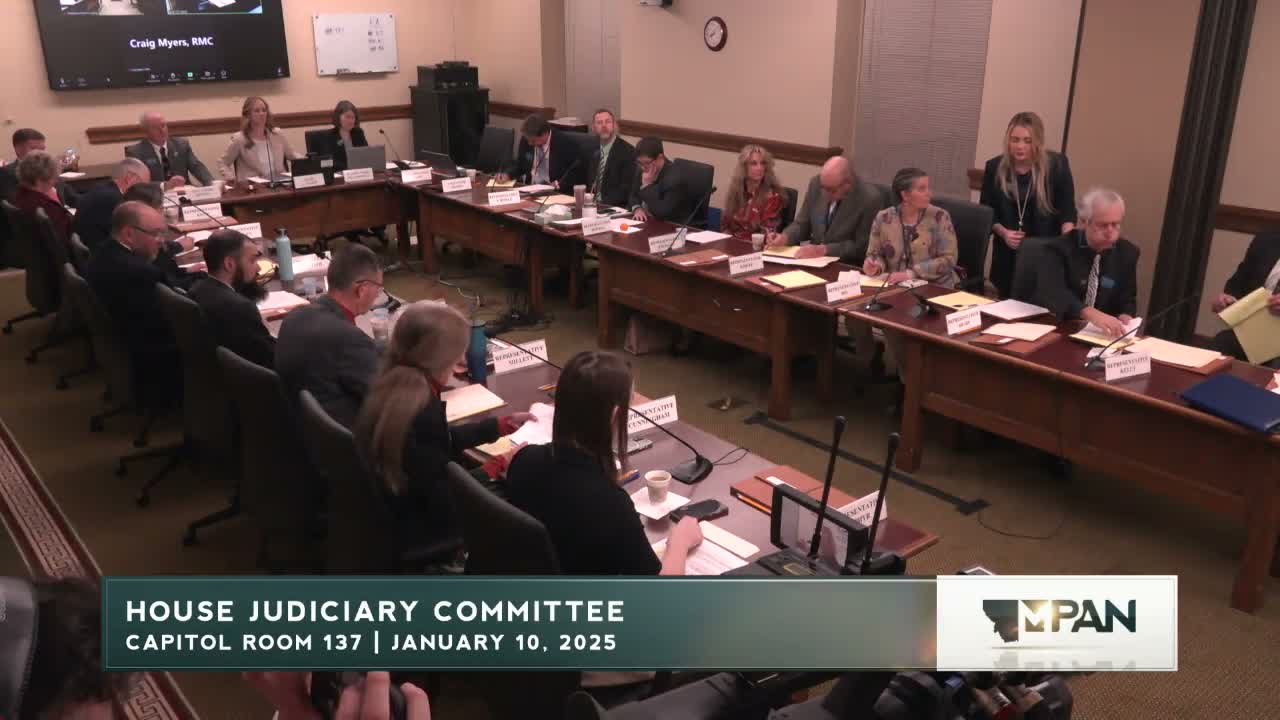
The House Judiciary Committee heard more than three hours of testimony on House Bill 121 on the bill’s first public hearing day, with supporters arguing the bill will protect "privacy, safety and dignity" for women and children and opponents saying it would discriminate against transgender, intersex and gender‑nonconforming Montanans and impose steep costs on public agencies and shelters.
Sponsor Carrie Seacens Crowe, who represents House District 39 in Billings, told the committee the measure — described by proponents as the "Protect Women Act" — is intended to provide a clear definition of biological sex and "reasonable exceptions to accommodate emergencies, custodial services, and ADA related needs." She said the bill focuses on three priorities: privacy, safety and clarity.
"This legislation simply reaffirms those values," Crowe said in opening remarks. "It is grounded in respect for science, longstanding cultural norms and the voices of parents, students and community members across our state." (Representative Carrie Seacens Crowe)
The lieutenant governor offered the governor’s office’s support during proponent testimony. "The governor stands with the legislature in protecting women and children," Lieutenant Governor Kristin Juras told the committee, urging members to "protect our rights." (Lieutenant Governor Kristin Juras)
Supporters included policy advocates and private citizens who recounted personal anecdotes they said illustrate risks to women and girls in shared facilities. Legal counsel for Alliance Defending Freedom framed HB 121 as compatible with the Americans with Disabilities Act and said the bill provides a private remedy for individuals harmed when a facility permits use of a multi‑occupancy space by an individual of the opposite biological sex.
Opponents were numerous and included the ACLU of Montana, Transvisible Montana, the Montana Coalition Against Domestic and Sexual Violence, LegalVoice, the Montana League of Cities and Towns, the YWCA and campus student representatives. They argued the bill is unnecessary, vague and unenforceable, and they said it would put shelters and other service providers at risk of losing federal funding or facing litigation.
"HB 121 discriminates against trans, intersex, and gender nonconforming Montanans and raises serious questions around privacy and enforceability," Khadija Davis, a lobbyist for the ACLU of Montana, told the committee. She warned that the bill "promotes stigmatization and discrimination" and that transgender people are already at heightened risk of harassment and violence.
Several shelter operators and domestic‑violence advocates testified that federal grant rules (including FVPSA funding) require nondiscriminatory services and that the bill’s requirements could put life‑saving programs and their funding at risk. Amanda Curtis, president of the Montana Federation of Public Employees, said employees who would be asked to enforce the bill’s provisions fear changes to their working conditions and exposure to lawsuits.
Committee members pressed both sides on implementation. Representatives asked how a covered entity would verify a patron’s biological characteristics, what "reasonable steps" would look like in practice, and whether the bill would create an uptick in litigation against local governments and universities. Sponsor counsel said the private remedy in the bill applies to covered entities (public buildings and institutions) rather than private individuals and that local facilities would define reasonable accommodations.
Many opponents emphasized the bill’s broad scope — arguing it covers not only public restrooms and locker rooms but also sleeping accommodations in prisons, jails, universities and shelters — and raised practical concerns about capacity and cost. Domestic violence shelter witnesses said many programs occupy small, house‑like facilities with single bathrooms and no practical way to segregate spaces without expensive renovations.
Student and campus witnesses said dorms with floor‑to‑ceiling stall doors and shared facilities provide privacy for most students and that changing those arrangements would be burdensome and likely unnecessary for the safety concerns cited by proponents.
No vote was taken on HB 121 at the hearing. The sponsor closed by urging a "do pass," saying the bill is about "safety and privacy of women in their most vulnerable spaces." The committee then moved to executive action on other bills; members were told to be prepared for further executive action on Monday.
What’s next: The hearing closed with no committee recommendation on HB 121. The sponsor asked for a "due pass," and committee staff said the item will remain on the committee’s schedule for future action. The Judiciary Committee proceeded to executive action on unrelated bills (see "Votes at a glance" for this hearing’s outcomes).