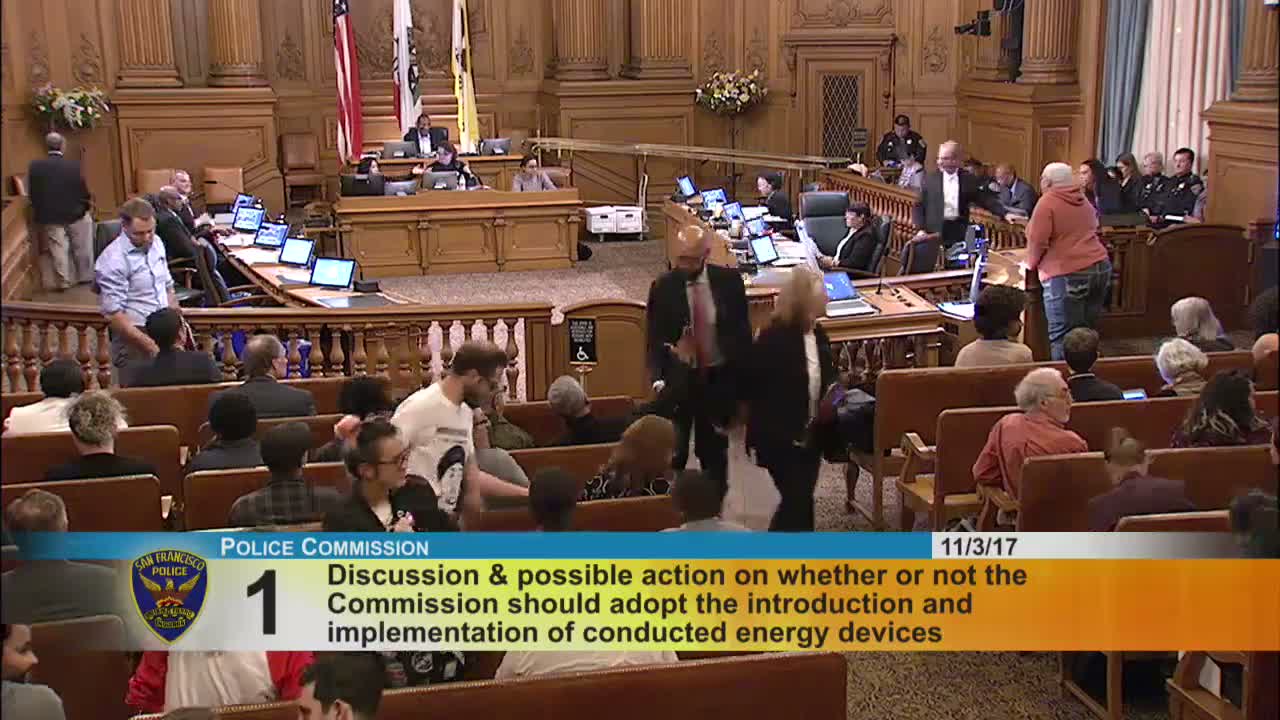
Hundreds of San Franciscans and experts urged the commission to reject tasers, citing safety and racial concerns
Loading...
Summary
More than a hundred public speakers and independent experts testified against adopting conducted energy devices, citing studies that show racial disparities, device failures and potential increases in in-custody deaths; supporters including some neighborhood police advisory boards and business groups testified for an intermediate force option.
Speakers filled and overflowed the commission room on Friday, making public comment the dominant portion of a hearing that ran for many hours. Dozens of scheduled speakers and many who waited in line urged the commission to reject tasers for the city—s police officers.
"These weapons are widely considered nonlethal, which is simply not true," Supervisor Sandra Lee Fewer told the commission, saying passage would be "irresponsible and shortsighted" while SFPD has outstanding Department of Justice recommendations. Health professionals who spoke at the hearing described people who are homeless, pregnant or have cardiac conditions as being at particular risk if CEDs are deployed in their communities.
Research testimony amplified those concerns. Kim Buchanan, a researcher who reviewed Connecticut reporting, summarized racial disparities in shock deployments and cautioned at-length about inconsistent reporting: "Black people and Hispanics were overrepresented among persons who received electric shocks by taser relative to population," she said. Epidemiologist Dr. Sang warned of a measurable short-term increase in in-custody sudden deaths and in officer-involved shootings after some jurisdictions adopted CEDs, and urged additional mitigations and independent study.
At the same time, community organizations and neighborhood advisory boards spoke both for and against. The Bar Association of San Francisco and several health advocacy groups formally recommended against adoption; by contrast, some community-police advisory boards and business representatives urged a nonlethal option for officers.
Multiple speakers criticized the meeting process: the hearing was temporarily moved and the room cleared after disruptive outbursts, and the commission then readmitted the public in limited batches; several speakers said that constrained access and harmed the process.
Taken together, the public record at the hearing was heavily weighted toward opposition: the Human Rights Commission summarized community meetings earlier in the process as showing roughly 85% of participants voiced concerns about adoption. Protesters, community groups and advocacy organizations told the commission the vote should reflect that public feedback.
After the vote, many opponents said they would continue to press the issue and watch implementation closely if the commission—s two-year delay is cleared in the future.