Get Full Government Meeting Transcripts, Videos, & Alerts Forever!
Get email alerts on the Per Diem Policy topic
No spam. Unsubscribe anytime.
Stevens County clarifies per‑diem rules; board adds canvassing‑board language
Summary
The board approved revisions to the county’s meeting-procedures and per‑diem policy, citing a 1994 opinion letter and Minnesota Statutes sections 375.055 and 375.06 that limit per‑diem to one payment per day; commissioners debated when per diems apply for committee and JPA service.
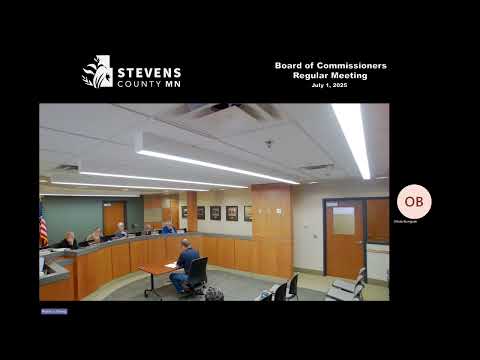
The Stevens County Board on June 25 approved revisions to its meeting procedures and per‑diem policy that clarify when commissioners may claim per‑diem payments.
County staff reviewed a 1994 opinion letter and cited Minnesota Statutes sections 375.055 and 375.06, telling the board that per‑diem is “per day” compensation for performing duties of the office and that multiple per‑diems for the same day are not authorized. As counsel summarized the guidance: “Per diem really is reflecting for the day's service, not in the traditional we sometimes use per diem for meals and incidentals” and “you cannot claim multiple per diems on the same day.”
Board members discussed scenarios that commonly raise questions—attendance at planning and zoning meetings, joint powers authority (JPA) duties, canvassing board responsibilities, and whether attendance as a member of the public or as an official delegation triggers per‑diem eligibility. Staff explained that per‑diems may be allowed when a commissioner is acting in the official discharge of duties (for example, chairing or attending required committee or JPA meetings) but not for duplicative claims for the same day.
Several commissioners expressed a desire to retain the ability to attend outside meetings to stay informed; staff and counsel repeatedly cautioned that commissioners who attend an outside body must avoid participating in decision making or creating a de facto quorum that would complicate open‑meeting requirements.
A motion to approve the draft policy with an explicit canvassing‑board per‑diem provision carried by voice vote. Staff indicated they will add specified language addressing canvassing-board payments to ensure the policy aligns with statutory limits.
The board did not vote to change salary or mileage policies; the action was limited to clarifying per‑diem application and meeting procedures.