Get Full Government Meeting Transcripts, Videos, & Alerts Forever!
Get email alerts on the Land Use topic
No spam. Unsubscribe anytime.
Vero Beach council approves Riverside Theatre back‑of‑house expansion and rezones park area to P‑3
Summary
After hours of public comment about tree loss and mitigation, the council approved a 5,803 sq. ft. backstage expansion and two covered loading docks for Riverside Theatre and adopted a related zoning map change to P‑3 for parts of Riverside Park. Staff said the project meets land‑development standards; vote was 5–0.
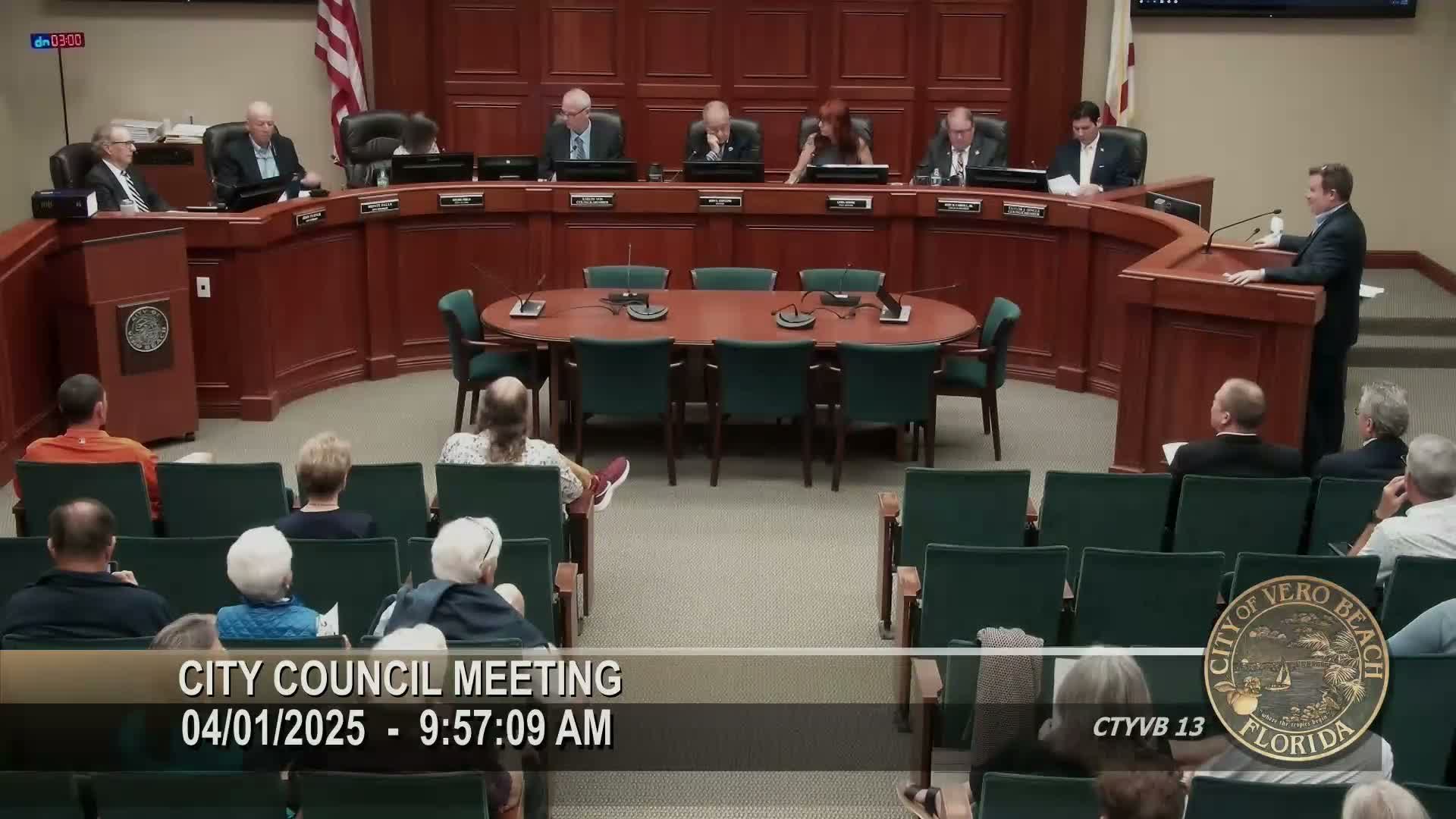
The Vero Beach City Council voted 5–0 on April 1 to approve a minor site‑plan application for a 5,803‑square‑foot back‑of‑house expansion and two covered loading docks for Riverside Theatre and concurrently adopted an ordinance rezoning roughly 22.96 acres in Riverside Park from P‑2 (Neighborhood Park) to P‑3 (Community and Special Facility Park).
City planning director Jason Jeffries told the council the proposal meets the comprehensive plan and land‑development regulations and that review found the expansion complies with setback, height, parking and stormwater standards. Jeffries also told the council the theater’s lease requires council approval of site improvements and that the application was processed as a quasi‑judicial hearing under Florida Statute Section 65.23.
The theater’s project manager, Keith Kite, said the work addresses an immediate operational need: “We want to be ready for next season … we have trailers out there in lieu of the scene shop,” and the indoor scene shop would remove the temporary trailers now on site. Kite said the team will present a master site plan later and that the applicant has engaged an arborist to assess trees and mitigation options.
Residents and conservation advocates urged the council to protect mature oaks. Richard Baker of the Pelican Island Audubon Society told the council, “We have to be very careful when we decide we want to get rid of 28 trees,” noting the ecological value of the live oaks for birds and insects. Neighbors said the application felt premature without the master plan and asked the council to require clearer mitigation on where replacement trees would be planted.
Staff explained mitigation options under the city’s tree preservation rules: specimen trees can be relocated, replaced with specified minimum trunk diameter at breast height (DBH), or the applicant may pay into the city’s mitigation fund; Jeffries said mitigation funds are typically used for planting on public property and that future concept plans will offer further planting opportunities.
Council members said they wanted staff to track mitigation locations as the master plan is developed but noted the site plan under review occupies the theater’s original lease footprint and meets technical criteria. The motion to approve the site plan passed on a 5–0 roll call. The subsequent zoning map amendment to P‑3 — a designation staff said is intended to contain larger park uses while protecting other park lands from unplanned expansion — also passed 5–0.
What happens next: the applicant will proceed toward construction under the conditions in the staff memo and will return with more detailed master site‑plan materials; staff and council said they will follow up on mitigation and tree‑replacement plans as part of later approvals.