Get Full Government Meeting Transcripts, Videos, & Alerts Forever!
Get email alerts on the Transportation topic
No spam. Unsubscribe anytime.
Manchester board approves 25% raise for crossing guards amid staffing shortages
Summary
The Board of School Committee approved a 25% pay increase for crossing guards and a $100 clothing allowance, aiming to reduce vacancies and stabilize morning/evening student crossings. The board discussed recruitment limits, budget impacts and MOUs to expand staffing pools.
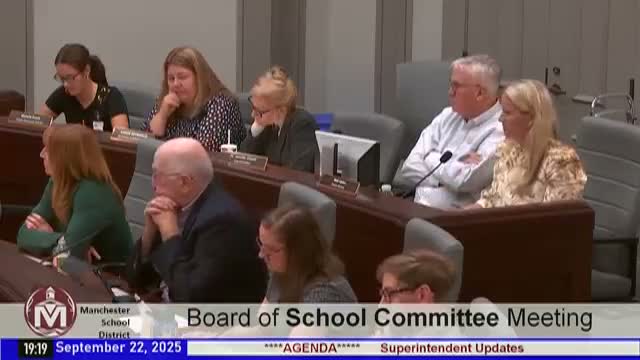
The Manchester Board of School Committee voted to raise crossing-guard compensation by 25% and to offer a $100 annual clothing allowance, a move district leaders said is intended to reduce vacancies and improve student safety during arrival and dismissal.
Assistant Superintendent Dr. Espinola outlined three options for changing compensation and recommended a plan that would give current staff a 25% increase (proposal 3). Under the proposal, starting pay that averaged about $15–$17.50 per hour would rise, and a typical crossing guard’s annual pay would go from about $6,100 to roughly $7,700. Dr. Espinola said the chosen option would be about $8,474.37 over the crossing-guard line-item budget but noted that $52,602.83 remained budgeted in that line because prior budgets assumed more hours than were worked.
"Given the importance of this role in protecting our students as they travel to and from school, we need to take action to remain competitive and support our employees," Dr. Espinola said. She also described how the district surveyed neighboring districts on hourly rates and hours to set a competitive level.
Committee member Baines moved to support the superintendent’s recommendation with the modification that the shoe allowance become a clothing allowance; Committee member Turner seconded the motion. Board members debated whether pay increases alone would solve recruitment challenges and discussed alternative staffing strategies including memoranda of understanding (MOUs) with other bargaining units, enlisting paraprofessionals or retired teachers, and working with community partners to expand candidate pools. Finance staff clarified the specific budget impacts and said the modest overage could be accommodated in the crossing-guard line item.
Several members emphasized urgency. "We gotta do something like yesterday," one member said during debate about families’ safety concerns. Supporters argued the pay increase combined with recruitment partnerships and flexibility could stabilize coverage; some members said volunteer or programmatic approaches could supplement paid staff but must be voluntary and compensated when required.
The motion passed by voice vote. Next steps include finalizing payroll changes and coordinating any required MOUs to allow district staff or community partners to help fill crossings while maintaining pay protections and volunteer rules.