Get Full Government Meeting Transcripts, Videos, & Alerts Forever!
Get email alerts on the Comprehensive Plan topic
No spam. Unsubscribe anytime.
County committee advances STL Co 2050 comprehensive plan to council agenda after staff presentation and public support
Summary
St. Louis County planning staff and AECOM presented the draft STL Co 2050 comprehensive plan, highlighting a digital 'living' plan with about 200 recommendations across five focus areas; the council voted to place proposed ordinance language calling for legislation on the unfinished business agenda.
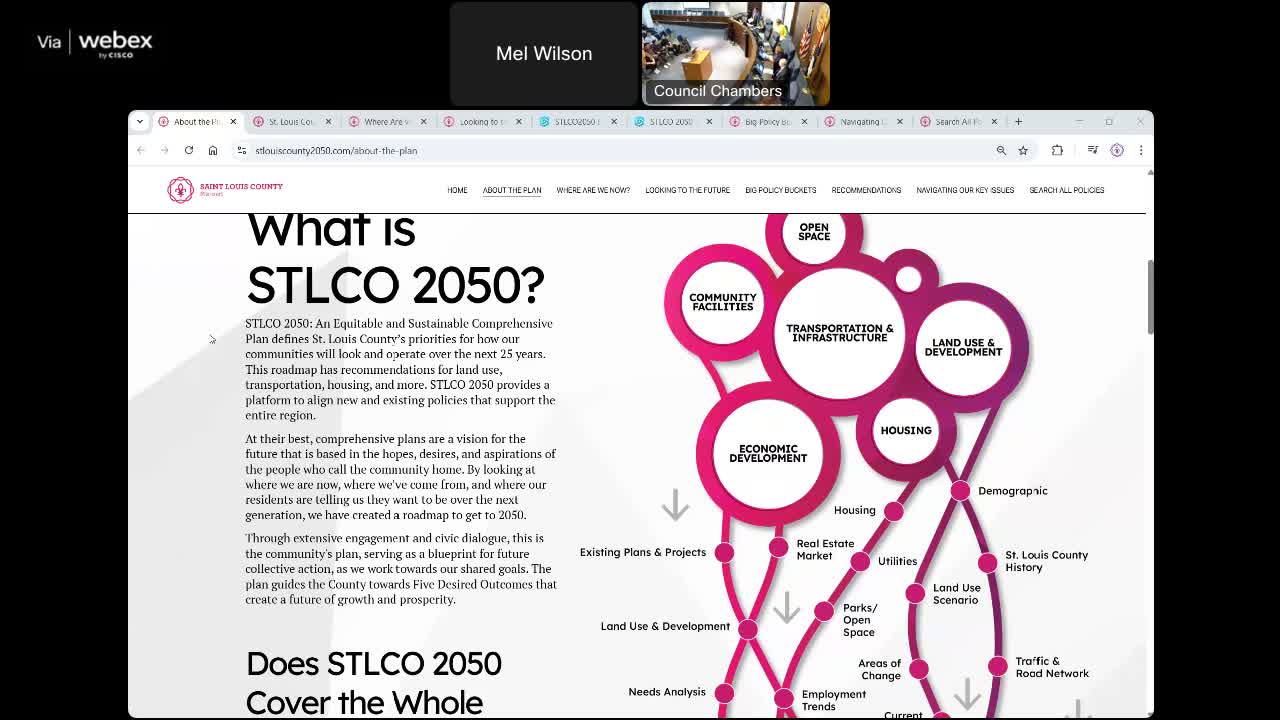
St. Louis County planning staff on Tuesday presented STL Co 2050, a digital, equity‑focused comprehensive plan the county says contains roughly 200 recommendations to guide land use, housing, transportation and infrastructure through 2050. After the presentation and brief council discussion, Councilwoman Clancy moved to place proposed ordinance text on the council’s unfinished business agenda; the motion carried by voice vote.
The presentation was led by Mel Wilson, deputy director of planning, and Steven Duong, principal with AECOM, after Jacob Trimble, the county’s director of planning, introduced the project team. Wilson told the Committee of the Whole that the plan is intended not just as a land‑use blueprint but as a countywide strategy that aligns department operations and helps partners prioritize investments. "STLCo 2,050 is a vehicle for reaching that destination in a way that includes all of us," Wilson said.
Staff emphasized the plan’s five desired outcomes—safe and thriving communities; equitable growth and opportunity; fiscally responsible infrastructure; housing opportunities for all; and social and environmental resilience—and described five policy “buckets” to organize recommendations: Inclusive Economies, Complete Communities, Sustainable Infrastructure, Responsible Growth and Leading the Region. Duong said the digital format lets residents and officials "dive as deep or further than we are in this plan" and see the data that informed the recommendations.
Presenters highlighted challenges the plan seeks to address, including a county population that "hasn't grown in 50 years," westward development that raises infrastructure maintenance costs, a mismatch between resident skills and available jobs, and a shortage of smaller, more affordable housing choices. Wilson said the plan includes a future‑place‑types map with 15 place types and that staff modeled multiple scenarios—including transit‑oriented development and floodplain changes—to test outcomes for housing and jobs.
Council members asked how the county would ensure implementation and accountability. Councilwoman Clancy urged that department budget requests and legislative proposals be linked back to the plan. Wilson described proposed accountability tools including semiannual working sessions, an "implementation orientation" to bring stakeholders together, and tying department work and future zoning updates to the plan’s five priorities. Jacob Trimble said a zoning ordinance overhaul is likely to be a major implementation task and is expected to be part of the department’s 2026 budget request.
Four public speakers voiced support at the meeting. Billy Brennan, speaking on behalf of the Saint Louis Zoo and its WildCare Park in Spanish Lake, thanked staff and offered the Zoo’s assistance so the plan will "not collect dust." Joe Colessa, acting deputy director for Transportation and Public Works, called the plan "a ray of hope" and pledged his department’s cooperation on zoning and infrastructure work. Paula Hart of the Planning Commission praised the outreach and public involvement that informed the draft. Charlie Hinderliter of the Saint Louis Realtors urged zoning reform and more housing types such as accessory dwelling units and multiplexes.
After public comment, Councilwoman Clancy moved "to recommend that we move forward the call for legislation tonight on the agenda for this item" to place staff’s proposed ordinance text on unfinished business. The motion received a second (not named in the record) and carried on a voice vote. No roll‑call vote or named tally was recorded in the transcript.
The committee closed by moving and approving adjournment. The council’s next procedural step, as described by staff, is the drafting and formal introduction of ordinance language and subsequent consideration during the council’s unfinished business process.