Get Full Government Meeting Transcripts, Videos, & Alerts Forever!
Get email alerts on the HB324 topic
No spam. Unsubscribe anytime.
Witnesses cite insurance-claims analysis in support of Patient Protection Act; committee seeks peer-reviewed data
Summary
Supporters of HB324 told the House Health Committee the Patient Protection Act would require in-person exams and stricter dispensing for drugs tied to severe adverse events; a witness cited an insurance-claims analysis alleging higher-than-reported complications from mifepristone, prompting members to request the study's methodology and peer review.
The House Health Committee heard proponent testimony on House Bill 324, the Patient Protection Act, which sponsors say would require in-person care and additional safeguards for medications associated with serious adverse events.
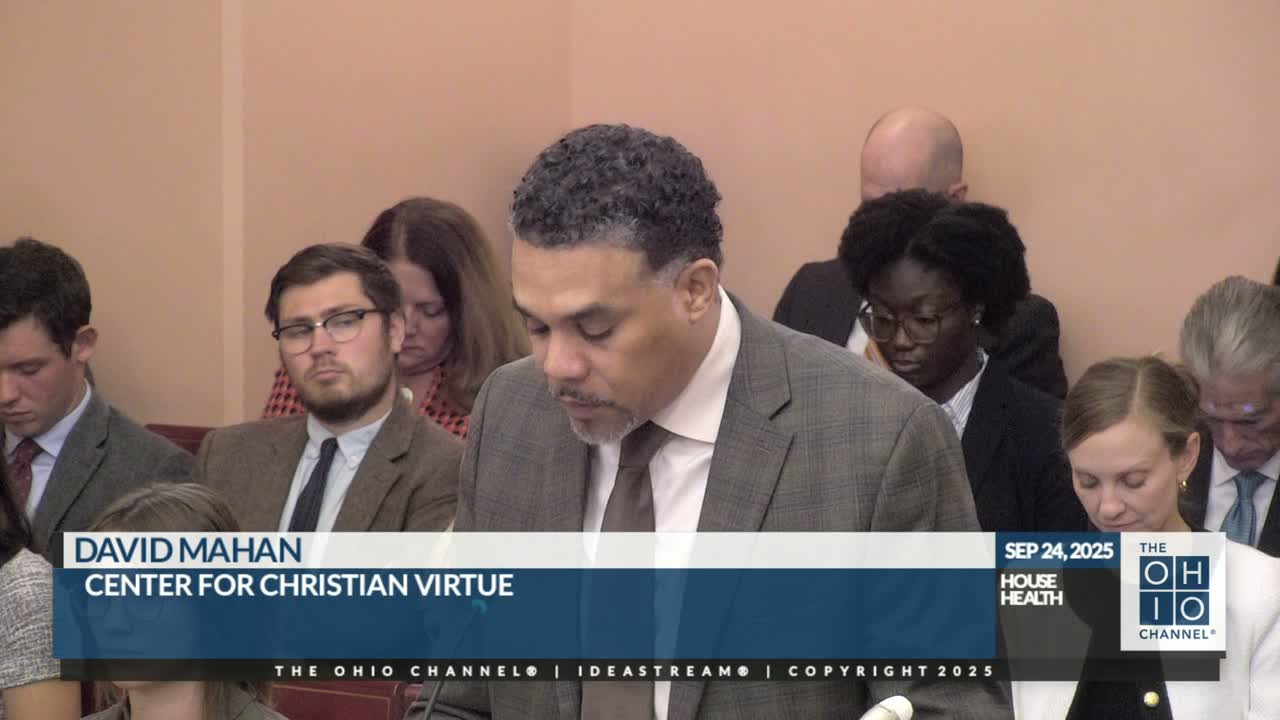
Marsha Forsen of the Catholic Conference of Ohio testified that the measure "employs reasonable safeguards on the dispensing of medications known to cause serious adverse effects by prohibiting the sale of such drugs without a prescription and requiring that patients be fully informed as to the associated risks." David Mahan of the Center for Christian Virtue later cited an analysis he said used insurance-claims data covering roughly 865,000 cases and reported that the real-world serious-adverse-event rate for mifepristone was "22 times higher" than the rate on the drug label and that nearly 11% of women in the dataset experienced sepsis, hemorrhage, transfusion, hospitalization or surgical intervention within 45 days.
Committee members pressed witnesses for methodological detail. Representative Samani asked whether the cited adverse-event rate applied to uses of mifepristone for non-abortion indications; the witness said the analysis used coding to identify abortion-related use but could not answer every methodological question during the hearing. Representative Baker and others noted the material presented included an article rather than a peer-reviewed study and requested access to the underlying research and coding methodology.
Witnesses said the bill is not narrowly focused on a single drug but would apply to any medication that demonstrates a severe-adverse-event rate above the bill's stated threshold (witnesses cited a 5% rate as the legislative cutoff). The committee requested follow-up documentation; sponsors and witnesses offered to provide the underlying study and to coordinate additional testimony by clinicians and researchers.
No vote was taken; the hearing ended with members asking for more evidence and written testimony available on committee devices.