Lifetime Citizen Portal Access — AI Briefings, Alerts & Unlimited Follows
U.S. Department of Education walks rural districts through SRSA eligibility, fund access and allowed uses
Loading...
Summary
REAP program officers outlined how small, rural LEAs qualify for SRSA grants, how awards are calculated, deadlines and the 27‑month performance period, how to draw funds from G5 (active UEI and payee access required), and flexible allowable uses including the alternative fund‑use authority.
The U.S. Department of Education’s REAP team delivered an orientation for Small Rural School Achievement (SRSA) grantees, laying out eligibility rules, how SRSA awards are calculated, the process to access funds through G5, and the flexible uses permitted during a 27‑month performance period.
The presentation began with Jordan Haydel, a program officer on the REAP team, who said the webinar was designed "to highlight the main things that an administrator should know about the program in order to make decisions about a school district's SRSA grant." The REAP presenters emphasized that the SRSA program is intended to help small rural local education agencies (LEAs) use federal resources more effectively and participate in ESEA title programs.
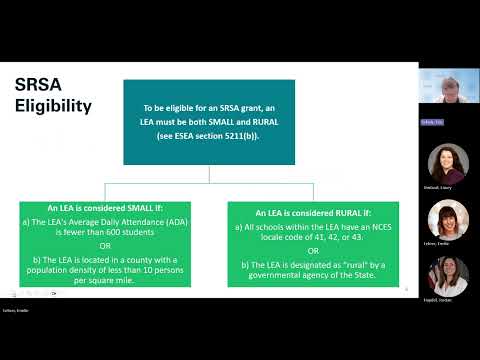
On eligibility, REAP staff said an LEA qualifies as "small" if its average daily attendance is under 600 or it is located in a county with population density under 10 persons per square mile. REAP staff also noted an LEA is rural if all its schools have NCES rural locale codes 41, 42, or 43, or if a state has designated the LEA as rural for SRSA purposes. "An LEA is considered small for SRSA if its average daily attendance is under 600," a presenter said.
The team explained award calculation in plain terms: the simplified initial amount is based on average daily attendance ((ADA − 50) × 100 + $20,000), subject to a statutory minimum initial award of $20,000 and a maximum initial amount of $60,000; REAP then subtracts prior‑year Title II‑A and Title IV‑A amounts and applies a ratable adjustment based on total appropriations and the number of applicants, which can cause year‑to‑year changes in award amounts.
Presenters walked through the grant calendar: eligibility data collection begins in October, the Master Eligibility Spreadsheet (MES) is published in January for LEAs to review and correct data, the personalized SRSA application is emailed in early spring, cohorts are finalized in May–June, and awards typically begin July 1. REAP noted liquidation deadlines and performance periods: each SRSA grant has a 27‑month performance period (the GAN typically shows a 15‑month award period plus an additional 12 months for obligation/liquidation); the slides also referenced January 30 liquidation deadlines for certain prior awards.
On documentation and monitoring, REAP staff repeatedly said grantees do not need to submit invoices or supporting documentation to the REAP team to draw down SRSA funds in G5, but they must keep transparent internal records (financial records, correspondence, receipts) for three years from the date of final expenditure because the Department may select grantees for monitoring.
Emily from the REAP team covered technical access: G5 is "the Department's grant management platform," and the Grant Award Notification (GAN) shows award details and contacts but does not itself confer payee authority. To access funds, an LEA must have an active UEI in SAM.gov, a G5 account with payee access, and a bank account linked in G5. REAP recommended maintaining active UEI registration (UEIs expire annually) and adding an additional entity administrator in SAM.gov to avoid delays.
Lainie reviewed allowable uses and compliance: SRSA funds may be used for allowable activities under Title I‑A, Title II‑A, Title III, and Title IV (parts A and B) of the ESEA, but the funds remain Title V for reporting. Expenditures must meet uniform administrative requirements, cost principles, and audit standards and be reasonable, necessary, allowable and allocable. REAP explained the supplement‑not‑supplant standard and listed three situations that would create a presumption of supplanting (ordinarily funded by other sources, previously funded by other sources, or state/federally required), while noting LEAs can document why an activity is supplemental.
REAP also described the alternative fund‑use authority (referred to in the presentation as AFWA), which allows SRSA‑eligible LEAs to treat Title II‑A and Title IV‑A formula funds with SRSA flexibilities (LEAs must notify their SEA if they intend to exercise that authority and follow state deadlines). The presenters said AFWA does not transfer funds between programs; it provides additional spending options for Title II‑A and Title IV‑A funds for eligible LEAs.
To close, presenters pointed viewers to the REAP informational document, REAP resources page, REAP FAQs, and the LEA financial status reports that the REAP mailbox sends to two contacts when an award has a remaining balance; they reiterated that REAP does not operate the G5 platform and directed LEAs to the G5 help desk or fsd.gov for SAM/G5 technical assistance. Viewers were given the REAP contact reap@ed.gov for program questions.
The orientation provided a practical checklist: confirm MES contact information in January, maintain an active UEI in SAM.gov, ensure someone in the LEA has G5 payee access and a linked bank account, keep internal records for three years, and consult REAP resources or the SEA before exercising alternative fund‑use authority.