
Board approves duplex at 800 E. Grimes, denies petitioner's sidewalk variance
Get AI-powered insights, summaries, and transcripts
Subscribe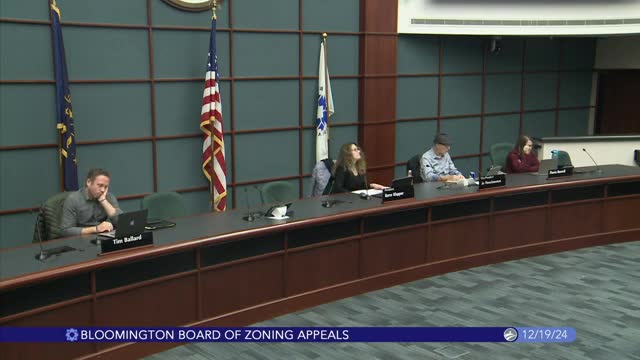
Summary
The Board of Zoning Appeals approved a conditional-use permit for a two-unit duplex at 800 East Grimes Lane but denied the petitioner’s request to waive sidewalk construction, imposing required sidewalks and street-tree conditions.
The City of Bloomington Board of Zoning Appeals on Dec. 19 approved a conditional-use application allowing construction of a one-story duplex with two two-bedroom units at 800 East Grimes Lane, and denied the petitioner’s request for a determinant sidewalk variance.
Planning staff presented the case and recommended approval of the conditional use while recommending denial of the sidewalk variance. As staff summarized, “we are recommending that the board adopt the findings and approve the conditional use request, but deny the determinant sidewalk variance request, with the 3 conditions that are listed in staff's report.” The staff report said the proposal meets use-specific standards (roof pitch, porches, setbacks), connects to existing utilities, and advances comprehensive-plan goals for infill and housing diversity, but staff found no practical difficulty or peculiar condition that would justify eliminating required sidewalks.
Petitioner representative Ernest Shee — sworn before speaking — said the project team held the required neighborhood meeting, incorporated suggested changes and that constructing sidewalks at the site would create an "island" sidewalk segment that would not match adjacent facilities and would be "not very aesthetic or functional." He said the north side of Grimes has a continuous sidewalk while the south side contains scattered, nonconforming segments that would complicate a new installation.
Board members who supported denying the variance emphasized longer-term connectivity: one member said the board must consider the 10-year picture and that sidewalks installed now often connect as development continues. The motion, as moved and seconded by members on the dais, approved the conditional use limited to the design shown in the packet and denied the sidewalk variance. The board attached conditions requiring street trees (spaced no more than 30 feet apart), and installation of a 6-foot-wide sidewalk with tree plot and street trees along both frontages; any portions of the sidewalk not in the public right-of-way must be placed in a pedestrian easement.
The vote was recorded in the meeting as yes votes from Clapper, Brock Morton, Ballard and Burrell, and the motion passed. No members of the public spoke for or against the petition at the hearing.
The board’s action requires the petitioner to provide the specified pedestrian facilities and street-tree plantings as a condition of the conditional-use approval; staff also flagged that the planning director has some discretion to adjust tree-plot and sidewalk widths to better match existing facilities if appropriate during final engineering review.