Lifetime Citizen Portal Access — AI Briefings, Alerts & Unlimited Follows
Public urges SFPUC to sell turbines, prioritize low‑income solar and reject CT siting in vulnerable neighborhoods
Loading...
Summary
Public commenters and advocacy groups told the San Francisco Public Utilities Commission to sell combustion turbines (CTs) rather than study new generation siting and to protect low‑income residents in solar job programs. Staff said the commission’s policy remains to sell the CTs while studying cogen options only as an analysis concurrent with the sale.
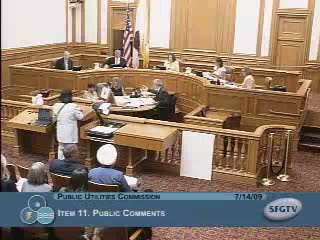
Public commenters pressed the San Francisco Public Utilities Commission on July 14 to prevent combustion turbines (CTs) from being placed in disadvantaged neighborhoods and to ensure low‑income residents benefit from solar programs.
Espinaldo Jackson of Bayview Hunters Point told commissioners he has been a homeowner and taxpayer since 1968 and asked the commission to "rescind a motion" made months earlier and to "reaffirm last year" that CTs not be sited in San Francisco neighborhoods; he asked that the issue be placed on a future agenda. Eric Brooks of the San Francisco Green Party and Our City said the Board of Supervisors’ recent vote sending a directive to the PUC to study CT reuse was not a "democratic process" and warned against developer pressure to site turbines in areas such as Potrero or SoMa.
Joshua Arce of the Bright Line Defense Project reiterated that the California Energy Commission (CEC) had previously rejected a Jesse Street CT site in 2006, citing cost and environmental impacts, and urged the PUC to "sell the CTs" and focus on transmission solutions and ISO actions rather than pursuing new generation in the city.
In its report to the commission, staff clarified the current policy position: the SFPUC's last policy decision was to sell the four CTs, and the board of supervisors' amendment directs staff to perform an analysis of cogeneration alternatives concurrently with the sale but does not authorize construction. The general manager said the staff has taken a "transmission‑only" approach to Cal ISO and will continue to pursue sale preparations while performing a feasibility study for potential cogen options. Staff cautioned that even if a cogen alternative appears viable, "it doesn't mean that our CTs would even be the ones that they'd wanna have or use in those sites."
Advocates framed their opposition in equity terms, urging the commission to ensure solar programs and any job opportunities related to solar reach San Francisco residents most in need. Commissioners asked staff about the scope and timetable of any study and whether it could be completed before the ISO meeting in the fall; staff said a study could be done in several months but that it would not delay the sale process.
The commission did not take a separate formal vote on the CT policy at the July 14 meeting; staff stated the sale remains the authorized option while an analysis may be undertaken at the supervisor's request. The record shows unsettled community concerns about neighborhood impacts, and staff noted legal and market dependencies if cogen alternatives were to be evaluated further.