Get Full Government Meeting Transcripts, Videos, & Alerts Forever!
Get email alerts on the Water Rates topic
No spam. Unsubscribe anytime.
SFPUC staff outlines multi‑year water and sewer rate increases tied to WESIP debt and cost-of-service adjustments
Summary
Staff told the San Francisco Public Utilities Commission that multi‑year rate changes — driven by the Water System Improvement Program (WESIP) and updated cost‑of‑service analyses — would raise average bills for single‑family and multifamily customers in the near term, and that low‑income subsidies and leak detection are part of mitigation strategies.
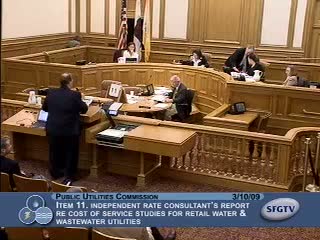
San Francisco Public Utilities Commission staff presented a proposal that would raise city water and sewer rates over the next five years to meet updated revenue requirements tied to the Water System Improvement Program (WESIP) and other capital needs.
Staff said the utility must cover a projected increase in annual debt service for WESIP from roughly $70 million to about $325–$330 million, and that the proposed rates are consistent with the commission’s 10‑year financial plans and the adopted 2009–10 budget. "We would require single family rates overall for water to go up about 13%, and for wastewater about 7.9%," staff said. The presentation included class‑specific projections over a five‑year period: multifamily water increases near 12% (wastewater ~11.8%) and commercial water about 13% with wastewater largely flat in early years.
Staff explained the recommended rate design leans toward simplifying tiers rather than moving to a uniform rate. The proposal would make two tiers for both water and sewer across single‑family and multifamily customers, phased in over three years to smooth sharp first‑year impacts. "We’re not suggesting you go to a strictly uniform rate on wastewater," staff said, noting the commission must also weigh charter‑mandated conservation considerations.
Examples provided to the commission showed average single‑family monthly bills rising from about $23.10 to $27.15 in year one (roughly a $4 increase, ~17.5%), and multifamily average bills rising from about $16.81 to $19.07 (~13.4% year one). Staff highlighted that wastewater first‑tier rates for single‑family customers would increase in the proposal from about $3.42 to $6.05 as part of cost‑of‑service recalibration.
Staff emphasized conservation and customer assistance as mitigation: automated metering infrastructure (AMI) adopted earlier in the meeting will allow more frequent reads and faster leak detection, and the commission was urged to expand rebate and conservation programs (example given: replacing toilets and washing machines can cut usage by about 20%). "There are a lot of these communication techniques that can be very useful in educating customers and making more efficient use of the resource," an on‑record speaker said.
The presentation also outlined distributional considerations: roughly 60% of retail water use is residential (24% single‑family, 35% multifamily) and household sizes vary by neighborhood, which affects how tiers impact different geographies (staff cited higher household sizes in the Southeast sector and higher landscaping usage in Pacific Heights). Staff noted the city’s per‑person consumption (~60 gallons/day) is below national averages and that suburban wholesale regions typically use twice as much water.
On timing and next steps, staff said proposed rates would be mailed as required under the California constitution to provide notice of the maximum proposed charges, with a formal adoption hearing scheduled for May 5. The staff presentation and consultant report will also be considered by the Rate Fairness Board in April before the commission’s adoption vote.
What’s next: staff asked commissioners whether to adopt a multi‑year rate approach (1–5 years) and to direct any additional modeling. The commission did not adopt rates at this meeting; the hearing on proposed rates remains scheduled for May 5.