Get Full Government Meeting Transcripts, Videos, & Alerts Forever!
Get email alerts on the Community Policing topic
No spam. Unsubscribe anytime.
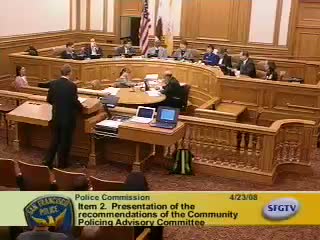
Police Commission receives community‑policing advisory recommendations; asks 90‑day implementation report
Summary
A mayoral advisory committee presented recommendations on language access, public‑housing policing, youth outreach, training and accountability; the San Francisco Police Department agreed with many proposals and the commission directed a date‑certain 90‑day report back on implementation.
A mayoral advisory group presented a package of recommendations to the San Francisco Police Commission on April 23, urging the department and city agencies to expand language access, strengthen public‑housing policing, increase youth engagement and create clearer accountability for community policing programs.
Kyle Peterson of the Mayor’s Office of Criminal Justice introduced the Community Policing Advisory Committee’s report, noting the document contains recommendations rather than a finished community‑policing plan. Cheryl Davidson, who led the committee presentation, said members met monthly for eight months in four working groups that focused on youth and families, public housing, language access and overall community‑policing structure.
Key recommendations include requiring district stations to communicate verbally and in writing in a district’s primary and secondary languages; staffing at least one bilingual officer for each major language in a district; producing multilingual monthly newsletters; creating a multilingual anonymous tip line; institutionalizing dedicated public‑housing officers and centralized information‑sharing between SFPD investigative units and housing partners; and expanding non‑emergency youth programs and SRO engagement in out‑of‑school activities.
SFPD representatives told commissioners the department concurs with many proposals and is already pursuing several. A department official noted the Police Executive Research Forum (PERF) is conducting an organizational evaluation and that the department has appointed a housing authority commander, Leroy Lindo, who is working to implement housing‑related proposals.
Commissioners asked for implementation detail. President Sparks said she would place a date‑certain 90‑day item on the commission agenda (July 23) requiring a report back on how each recommendation is being implemented or a detailed explanation for why an item cannot be implemented. Deputy Chief of Field Operations said SFPD will form an implementation team that will include Commanders Murphy, Tong and Lindo and will support tracking and accountability of the recommendations.
The presentation included specific operational details that commissioners asked staff to clarify: presenters said the department had five MOUs under an original housing agreement and that about eight public‑housing developments currently have formal arrangements out of roughly 51 sites; presenters said those pilot assignments were based on high‑crime areas and resource constraints. The Office of Citizen Complaints later noted 27 community members participated in the advisory work.
The commission’s action was procedural: it did not adopt an ordinance or formal rule but directed the department to return in 90 days with an itemized implementation plan or documented reasons an item cannot be carried out. President Sparks requested that follow‑up include specific timelines, responsible bureaus and explanations for any resource or legal barriers.
What’s next: Commissioners expect a July 23 report‑back on individual recommendations and SFPD said it will begin implementing items that are feasible before that date.