Get Full Government Meeting Transcripts, Videos, & Alerts Forever!
Get email alerts on the Public Safety Cameras topic
No spam. Unsubscribe anytime.
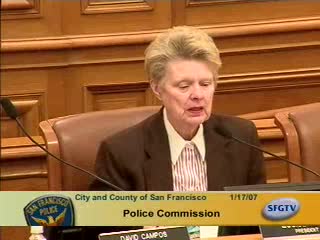
San Francisco Police Commission approves pilot plan for street cameras after hours of public comment and new safeguards
Summary
After hours of testimony from dozens of residents, merchants and civil-rights groups, the San Francisco Police Commission approved the mayor's proposal to add community safety cameras at multiple high-crime intersections, adding conditions on evaluation, retention and use, and directing policy to disable cameras during permitted demonstrations.
San Francisco ' The Police Commission voted to approve the mayor's Office of Criminal Justice proposal to install a pilot network of community safety cameras at several city intersections, after a lengthy hearing during which dozens of residents, merchants and civil-rights advocates offered often sharply divergent views.
Alan Nance, acting director of the mayor's Office of Criminal Justice, told the commission the office recommends cameras at Third & Newcomb, 16th & Mission, Turk & Taylor, 1050 McAllister, Geneva & Mission, 20th & Mission, Ellis & Jones and 20th & Shotwell, and added 3 cameras at 20th & Shotwell following recent shootings in that area. He said the office expanded multilingual outreach, met with ACLU representatives, held a community meeting convened by Supervisor Daly and posted FAQs and crime data online to prepare for the rehearing.
"We have added the location of 20 Sixth and Shotwell and are requesting 3 cameras at that location," Nance said, summarizing both site selection and outreach. He described signage, daily site reviews by the Department of Telecommunications and Information Services, and efforts to pair cameras with foot patrols and lighting.
Opponents, including civil-liberties groups and academic researchers, urged the commission to pause and evaluate existing installations before expanding the program. ACLU witnesses and academic advisers presented data packets and said that in many jurisdictions cameras had not reduced crime; they argued cameras can be intrusive, subject to mission creep and vulnerable to Public Records Act requests or other legal orders.
"Video surveillance cameras that monitor and track us enable the government to create dossiers about our personal lives," Nicole Ozer, technology and civil-liberties policy director at ACLU Northern California, said. She urged the commission to weigh privacy and free-speech risks alongside safety claims.
Supporters from neighborhood associations, merchants and tenants'advocacy groups testified that cameras could help identify assailants and provide evidence in cases where witnesses are unwilling to come forward. Several speakers described shootings, robberies and repeated nuisance crimes near proposed sites and submitted petitions or signatures backing installations.
"A camera would have been a very instrumental tool in identifying this shooter and could have led to the capturing, prosecution [and] sentencing of this individual," said Catherine Pacheco, who described family members injured at a Mission-area intersection.
Commissioners pressed the mayor's office on multiple points: why specific sites were chosen, what evidence supports deterrence in San Francisco's context, how footage is accessed and by whom, retention and destruction schedules, whether privacy impact analyses had been completed, and what safeguards would limit future expansion or repurposing of footage. Nance said 33 cameras already exist citywide, that images are overwritten within the retention window the ordinance allows, and that the office has not yet completed a comprehensive evaluation but is committed to one.
Commissioner Veronese repeatedly asked for evidence and cautioned against expanding capabilities without clear policy limits; other commissioners suggested pairing cameras with lighting and expanded foot patrols and stressed the need for strong community engagement.
The commission approved the proposal with amendments. The approved motion includes explicit findings required by the ordinance, requires reports on effectiveness, confirms data-retention practices and destruction of images in line with ordinance limits, and adds specific safeguards the commission debated during the hearing. The motion directs the Department of Telecommunications and Information Services to establish a mechanism to disable cameras for permitted demonstrations and to participate in the evaluation process. The roll-call vote was recorded as unanimous in favor.
After the vote commissioners and staff reiterated that the cameras are one tool among many ' not a panacea ' and that the ordinance gives this body authority to remove cameras if subsequent reports show they are not meeting the statutory criteria for deterrence and community support.
The commission meeting was adjourned at 10:38 p.m.; the item will be subject to the reporting and review schedule specified in the ordinance.
Notes: The hearing record includes extensive public-comment packets and petitions filed with the commission and references to the ordinance that authorized the pilot (San Francisco Administrative Code provisions governing community safety cameras).