Get Full Government Meeting Transcripts, Videos, & Alerts Forever!
Get email alerts on the Open Government topic
No spam. Unsubscribe anytime.
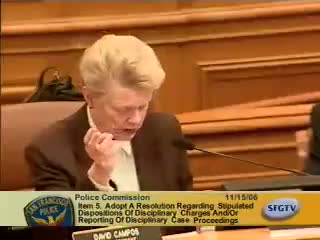
Police commission adopts policy limiting closed‑session stipulated dispositions after rejecting broader open‑settlements ban
Summary
After a lengthy debate, the commission rejected a proposed broad ban on secret or anonymous stipulations and instead adopted Commissioner Veronese’s policy on handling stipulated dispositions by a 4–3 vote; commissioners and civil‑liberties groups called for more transparency going forward.
The San Francisco Police Commission debated two competing resolutions about how stipulated disciplinary dispositions should be handled: an original, broader resolution that would have banned secret or anonymous settlements in disciplinary matters and a second, narrower proposal advanced by Commissioner Veronese.
Speakers for open proceedings — including representatives of the San Francisco Chronicle and the ACLU — argued that public confidence depends on transparency and urged the commission to avoid private settlements for serious matters. The broader ban did not carry when the commission voted; the original proposal failed and the commission then adopted Commissioner Veronese’s alternative policy by a 4–3 vote.
Commissioners framed the question as a balance between transparency and legal constraints, including ambiguity about how state law (as cited during the hearing) interacts with local practice on stipulated dispositions. Several commissioners said they supported greater openness but were constrained by legal uncertainty and recommended further review.
The action narrows how stipulated dispositions will be handled going forward and creates a new local policy for the commission’s process; commissioners and public‑interest groups urged rapid follow‑up to restore community confidence where appropriate.