Lifetime Citizen Portal Access — AI Briefings, Alerts & Unlimited Follows
DPH outlines Prop C spending plan, warns of $30 million structural shortfall; overdose deaths reported down 20%
Loading...
Summary
San Francisco Department of Public Health told the committee Prop C funds support residential treatment beds, outreach and case management but projected revenues (~$70M) fall short of planned proxy spending (~$100M), creating an approximate $30M gap; presenters highlighted a 20% drop in overdose deaths and data improvements after a May Epic EHR migration.
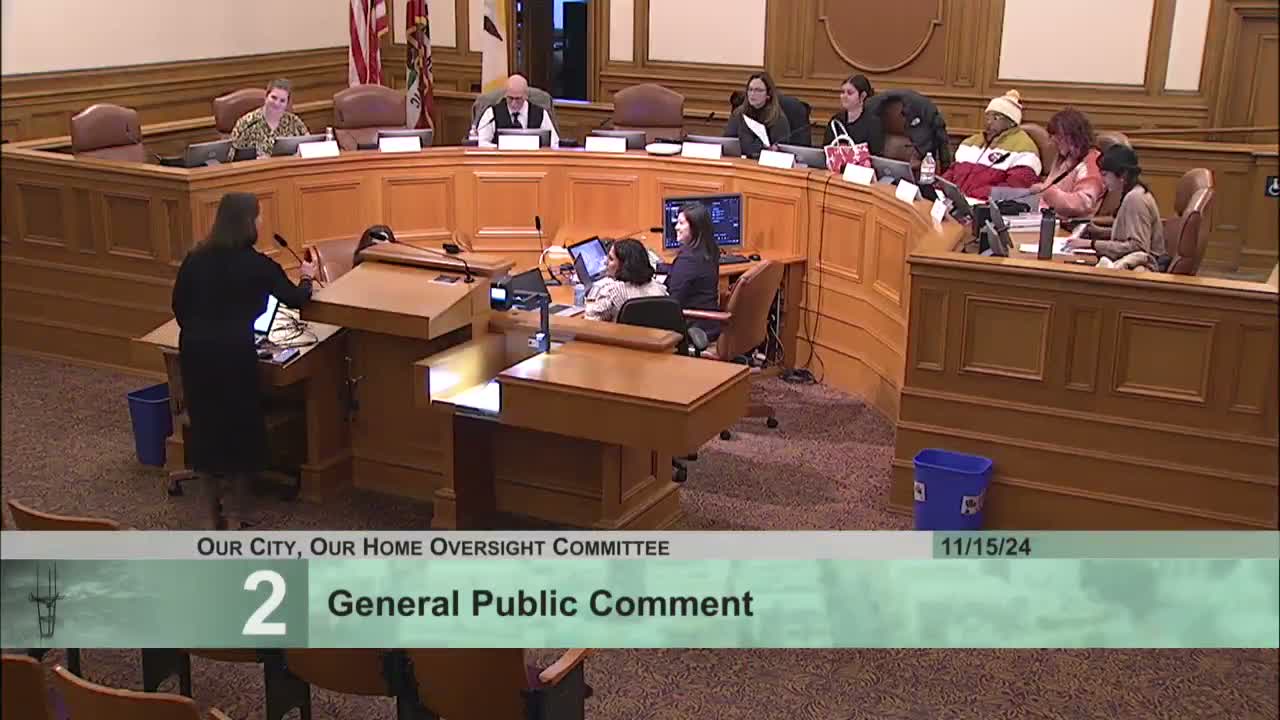
San Francisco — The Department of Public Health (DPH) briefed the committee on the mental‑health portion of the city's Prop C spending plan and warned that revenues are projected below planned proxy spending, creating a near‑term structural shortfall.
Director Kirkpatrick said DPH's overall budget is about $3,400,000,000 and the department's behavioral health services budget is roughly $663,000,000. "We receive approximately $100,000,000 a year in Prop C funding," Kirkpatrick said, noting that the largest single allocation in the plan is about $40,000,000 a year for residential care and treatment beds. She told committee members that revenues may be closer to $70,000,000 a year, "which leaves us currently at about a $30,000,000 structural shortfall." The department said it has relied on one‑time savings to sustain services while planning for tighter budgets in year three of the projection.
Why it matters: Prop C funds pay for a range of services across the behavioral health continuum — residential treatment beds, assertive outreach and case management, the Office of Coordinated Care (OCC) and overdose prevention work. Committee members repeatedly pressed staff to separate one‑time funding from ongoing revenue in future briefings so they can better assess sustainability.
Office of Coordinated Care director Heather Weisberg described OCC's structure and programs, including a behavioral health access line, a seven‑day behavioral access center and five field teams that provide triage, outreach, shelter‑based supports and targeted permanent‑supportive‑housing clinical services. Weisberg said OCC was created in 2022 and that the new Epic electronic health record, rolled out for behavioral health services in May, should improve the city's ability to "do the closed loop, see the ultimate connections into care" and track outcomes more effectively.
The Office of Overdose Prevention reported progress on several metrics. Emily Ragonold said the office has tracked a 20 percent reduction in overdose deaths citywide between January 2023 and January 2024 and a decline in 911 calls for overdoses from roughly 70 to about 50 calls per week. She highlighted a 35 percent increase in methadone admissions and said naloxone distributions rose about 16 percent in fiscal 2024 to nearly 200,000 doses.
Committee concerns and follow‑up: Members asked whether declines in fatal overdoses mean fewer overdoses overall or merely more successful reversals; presenters cautioned that 911 data capture only EMS‑attended events and that many reversals occur without 911 involvement. Members requested that future reporting include clearer outcomes (for example, median and mean lengths of stay in treatment beds, exit destinations for people leaving residential programs, and disaggregation of one‑time versus ongoing funds). DPH agreed to provide a one‑time vs. ongoing funding breakdown and additional data on bed length of stay, exits and precise Fire Department spending on assertive outreach (estimated in discussion at about $11M–$13M).
Votes at a glance: The committee approved a procedural motion to excuse Chair Williams and Member Martinez (moved by Member Walton; seconded by Member Friedenbach) and later approved the minutes of the prior meeting (moved by Member Walton; seconded by Member Jackson). The motions passed on recorded voice votes.
Next steps: Staff said they will return with more detailed budget breakdowns separating one‑time and ongoing funds, additional bed length‑of‑stay and exit metrics, and updates derived from the Epic integration that should improve outcome tracking. The committee also signaled interest in a future deep dive on data systems and outcome measures across departments.
All quotes are from committee meeting presenters and members recorded in the meeting transcript.