Get Full Government Meeting Transcripts, Videos, & Alerts Forever!
Get email alerts on the Housing Inventory topic
No spam. Unsubscribe anytime.
HSH reports rising outreach, steady shelter occupancy and persistent PSH vacancies
Summary
HSH told the Homelessness Oversight Commission that outreach encounters rose to over 2,900 in May and June 2024 and that the system made thousands of shelter and housing placements, while site-based PSH vacancy remains around 9%, above the department goal of 7%. Commissioners pressed HSH for more detailed vacancy tracking and faster unit turnovers.
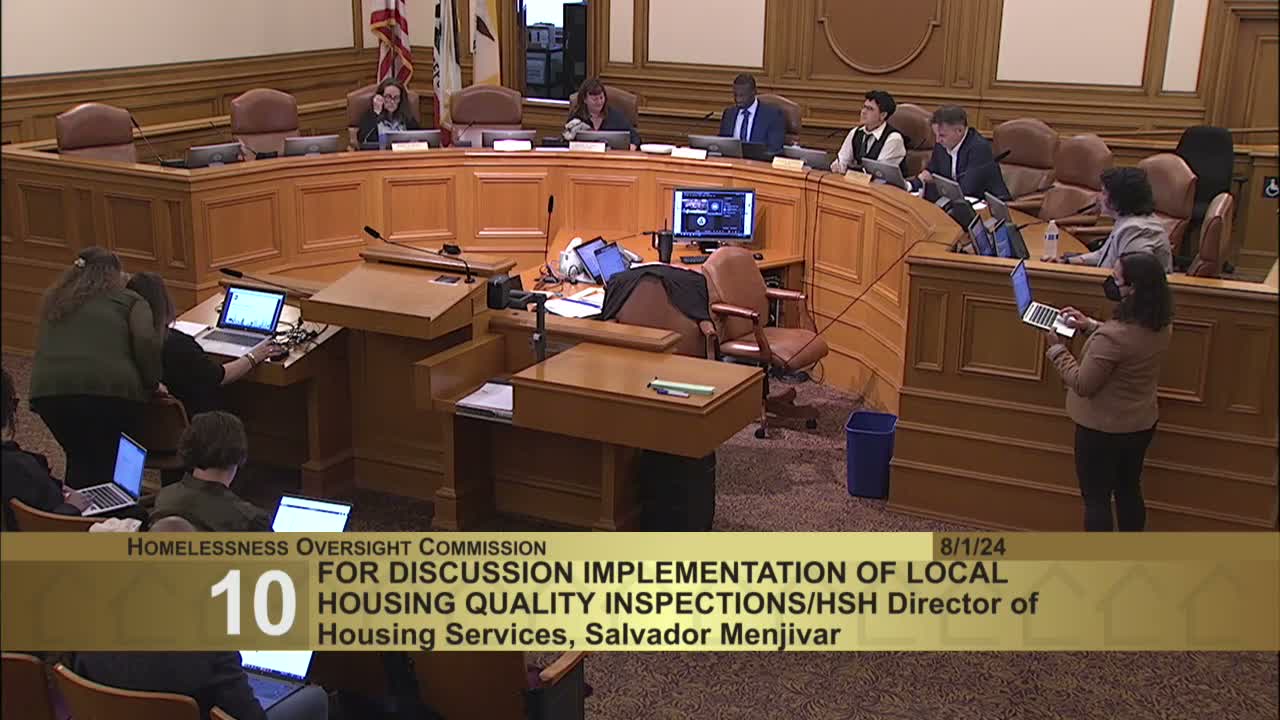
San Francisco’s Department of Homelessness and Supportive Housing (HSH) told the city’s Homelessness Oversight Commission in August 2024 that outreach encounters rose slightly in May and June, with “over 2,900 encounters each month,” and that its outreach team completed thousands of shelter referrals and several hundred housing placements over the 2023–24 fiscal year.
“Outreach increased slightly in May and June 2024 with over 2,900 encounters each month,” HSH executive director Shereen McSpadden said during the commission meeting, summarizing the department’s year‑to‑date results.
McSpadden said HSH’s homeless outreach staff made 1,453 shelter placements and roughly 2,192 referrals to coordinated entry access points in the fiscal year, and the department’s street‑to‑home program made dozens of direct permanent placements. HSH also reported that 4,339 households received emergency rental assistance in FY 2023–24, averaging about $6,246 in aid per household and totaling roughly $27.1 million distributed through SF ERAP.
Commissioners focused much of their questioning on the department’s permanent supportive housing (PSH) vacancy rate. HSH reported a 9.1% vacancy rate on its site‑based PSH portfolio as of July 2024, above its stated goal of 7%. Of those vacancies the department said roughly 2.6% had move‑ins in process, 4.6% were offline (often for maintenance or janitorial holds) and about 1.9% were available for referral.
“We changed our system a few months ago, which impacted our vacancy methodology,” McSpadden said, adding that some offline units require contractor work or have scheduling delays. Marion Sanders, HSH chief deputy, told commissioners the department expects typical turnover work to take three to four weeks but acknowledged some units remain offline longer due to contractor availability or significant damage.
Commissioners pressed staff for more granular monthly tracking and for a new reporting category to distinguish exits that are self‑sustaining versus those that require continued subsidy. “Can we have a category for self‑sustaining — in other words, not requiring subsidies anymore?” Commissioner Sharky Laguana asked. HSH said it could add reporting to reflect that distinction.
HSH also reported system successes elsewhere: a NOFA released in February made $10 million available for elevator modernizations at PSH sites, with 13 tentative awards covering 431 units; coordination with the Latino Task Force has helped place some clients together in shelter; and a long‑running Muni fine and fee waiver program has served roughly 43,000 people and dismissed over 35,000 tickets.
The commission requested additional follow‑up materials, including site‑by‑site vacancy ages, the walk‑up shelter utilization and turnaway numbers, and month‑over‑month changes to the reservation waitlist to better track trends and measure the effectiveness of unit‑filling strategies. HSH agreed to provide those data and said staff are working with providers to reduce time offline and improve unit readiness.