Get Full Government Meeting Transcripts, Videos, & Alerts Forever!
Get email alerts on the Whistleblower Legislation topic
No spam. Unsubscribe anytime.
Ethics Commission debates whistleblower ordinance, jurisdiction and possible charter amendment
Summary
The commission discussed the whistleblower protection ordinance adopted in January, heard criticism that penalties are insufficient, and debated preparing legislation or a background report to consider transferring intake authority from the Controller to the Ethics Commission via charter amendment.
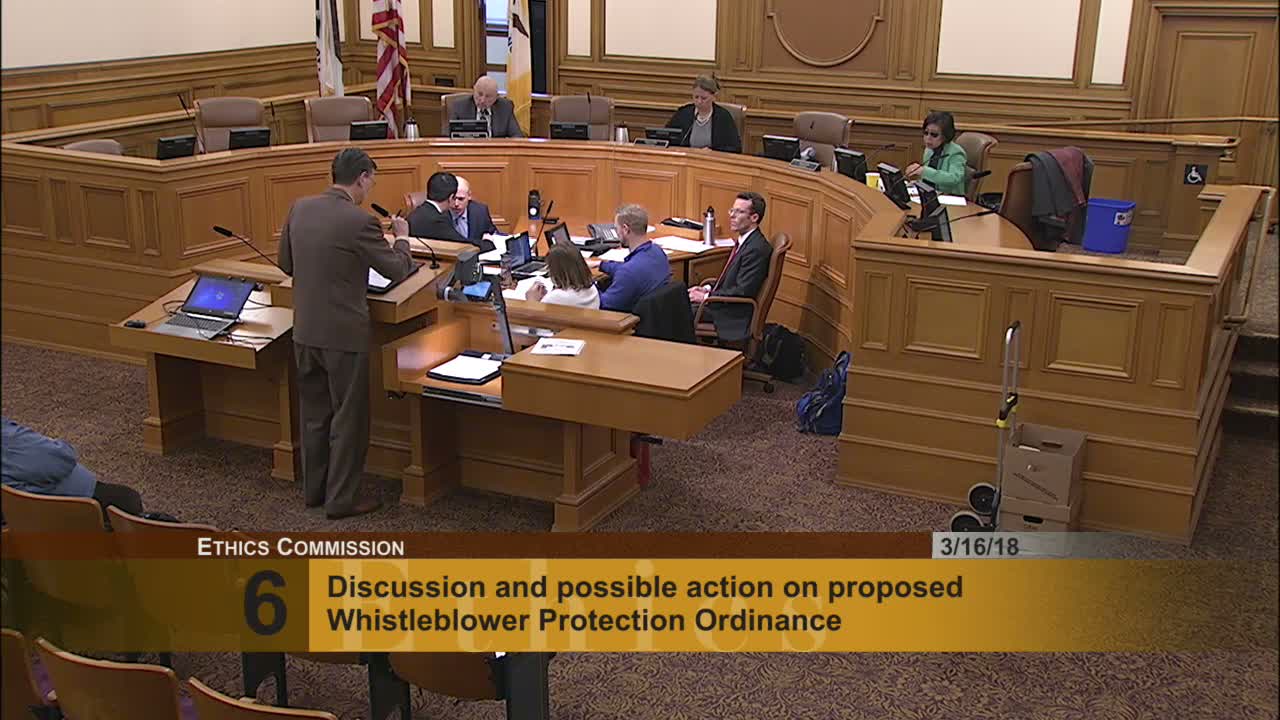
The San Francisco Ethics Commission discussed a whistleblower protection ordinance at its March 16 meeting, reviewing staff research and public input and debating whether to prepare draft legislation to transfer whistleblower intake authority from the Controller’s office to the Ethics Commission.
Dr. Derek Kerr, identifying himself as a whistleblower, told the commission the adopted ordinance lacks meaningful remedies such as reinstatement and that civil penalties—"a 2,000, dollars 10,000 civil penalty" in the draft—amount to only “a trivial 1 or 2 month salary" and often are paid from city funds. "There's really no protection without remedies," Kerr said, urging the commission to recommend that whistleblowers get private counsel and know they may contact media to expose misconduct.
Commissioners and staff debated jurisdiction and history. Staff told commissioners that, historically, the Controller’s office has been the primary intake office for whistleblower complaints while the Ethics Commission handles retaliation claims and that moving intake authority would require a charter amendment originating with the Board of Supervisors or a referendum. Commissioner Kopp requested preparation of draft charter amendment language to transfer authority and asked that it be placed on the April agenda; other commissioners favored receiving a staff briefing and historical analysis before requesting staff to prepare legislation.
Public commenters including Larry Bush and Bob Planthold urged the commission to act, pointed to a prior civil grand jury report that recommended returning whistleblower jurisdiction to ethics, and called for clearer public guidance about where employees should file complaints. Staff proposed preparing a policy/background document explaining current jurisdiction, legislative history and options for moving forward, and said that unless the commission provided specific policy direction, staff would proceed to reintroduce the previously adopted ordinance to the Board of Supervisors as planned.
No final decision changing jurisdiction was made at the meeting; commissioners agreed to further discussion and asked staff for background materials, with at least one commissioner formally requesting that draft legislation (a proposed charter amendment) be prepared for the April meeting and noted that his request be reflected in the minutes.