Get Full Government Meeting Transcripts, Videos, & Alerts Forever!
Get email alerts on the Housing topic
No spam. Unsubscribe anytime.
Abatement Appeals Board pauses enforcement at 109 Pierce Street, orders 30-day continuance
Summary
The Abatement Appeals Board voted 4–1 to continue an order-of-abatement case for 109 Pierce Street for 30 days after hearing competing accounts about mold, dry rot and whether repairs require tenant relocation. The board urged mediation and outreach, and asked both sides to seek a negotiated path forward.
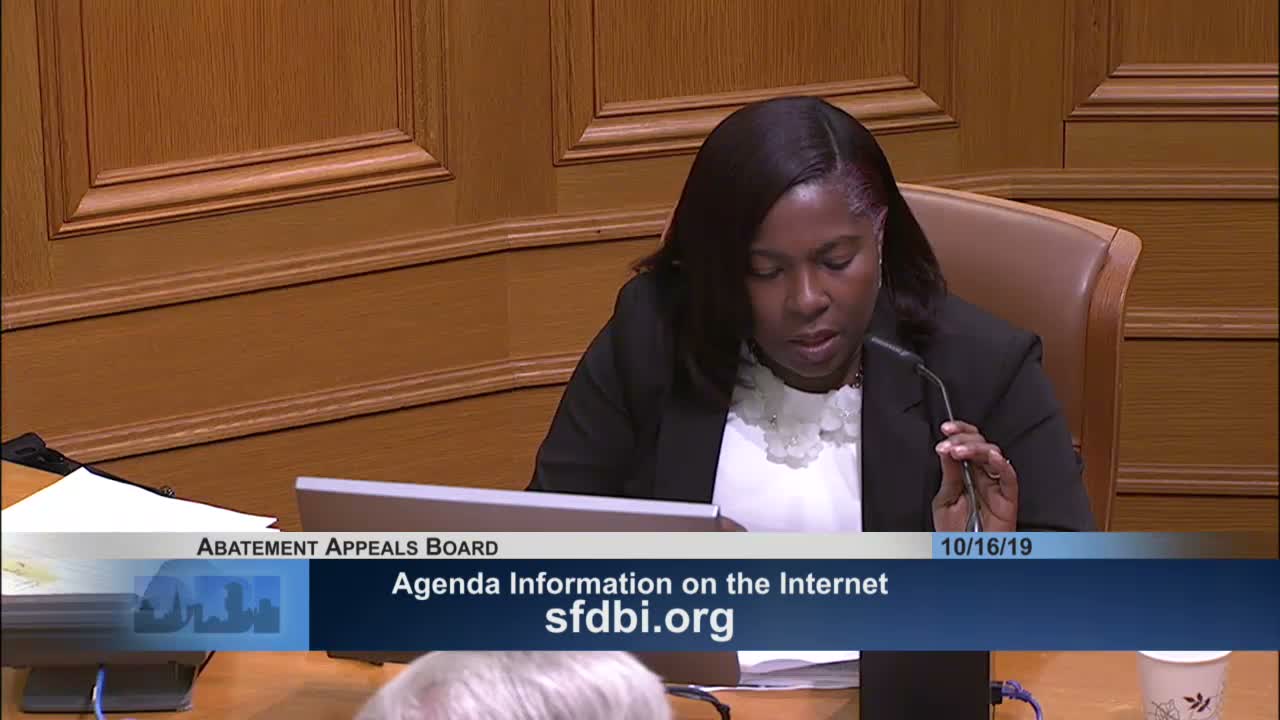
The San Francisco Abatement Appeals Board on Oct. 16 continued for 30 days an order-of-abatement case concerning 109 Pierce Street after hearing testimony about persistent mold, dry rot and an inoperable heater in an occupied unit.
Senior housing inspector Jose Lopez told the board that the city received a complaint on 08/29/2018 and issued a notice of violation on 08/31/2018. After inspections and multiple hearings, Lopez said, an order of abatement was issued on 07/11/2019; the department’s position was that the violations posed a life hazard to the occupant and that previous opportunities to correct the conditions had not produced lasting repairs.
Housing inspector Christina Moy described photographic evidence of the unit’s condition, including a warped rear exit door, mold on bedroom and bathroom ceilings and walls, and a nonworking heater. "This is the only heating unit, in the apartment, and it's not working," Moy said during her presentation. Moy reported a reinspection on 10/04/2019 and said the violations remained uncorrected; the department recommended upholding the order of abatement.
The owner’s attorney, Ryan J. Patterson, said the owner — identified in the record as Atilon LLC — bought the building about a year earlier and had opened permits and attempted repairs but faced difficulty securing access to the occupied unit. Patterson argued that "it would be very wrong for the city to penalize an owner for doing everything that they can do to abate the situation," adding that an abatement order could complicate the owner’s ability to obtain construction financing. Owner representative Andrew Mironov told the board that full structural work — including roof replacement, foundation repairs and removal of a rear stair — would likely require gutting walls and could take about 18 months to complete.
A neighbor, Hal Fisher, spoke on behalf of tenant Jackie Long and disputed aspects of the owner’s account. Fisher said the tenant is a 73-year-old African American woman with disabilities who has lived in the unit for decades, and he alleged the owner sought to convert units into larger or luxury flats. "This is a 73 year old African American woman who has her own disabilities," Fisher said, urging care in how displacement is handled.
Inspectors and several commissioners disagreed on how much of the work could be done while the tenant remained in place. Inspector Amore summarized enforcement steps and permit history, noting a final warning letter issued 10/09/2018, subsequent hearings and a permit for rear-stair work identified in a 06/19/2019 permit check; Amore urged the board to keep the abatement order in place based on the department’s safety finding.
Several commissioners urged the parties to explore negotiated options and involve outreach and mediation resources. Tenderloin Housing Clinic staff offered to engage and help mediate tenant-side representation and services. Commissioner Walker moved to continue the case for 30 days to allow outreach and negotiation; Commissioner McCarthy seconded. The roll-call vote was McCarthy Yes, Walker Yes, Clinch Yes, Moss Yes, President Warshaw No; the motion carried 4–1.
The board’s continuance directs staff and the parties to pursue mediation and code-enforcement outreach and to return to the Abatement Appeals Board at the next scheduled session. No final ruling on the order of abatement was made at the Oct. 16 hearing.