Get Full Government Meeting Transcripts, Videos, & Alerts Forever!
Get email alerts on the Municipal Finance topic
No spam. Unsubscribe anytime.
OCII OKs intent to form $6 billion community facilities district for Hunters Point/Candlestick
Summary
The Commission on Community Investment and Infrastructure approved resolutions of intent to form Community Facilities District No. 9 and to incur bonded indebtedness, clearing an early step toward up to $6 billion in financing for infrastructure, shoreline adaptation and long‑term maintenance in the Hunters Point Shipyard/Candlestick Point area.
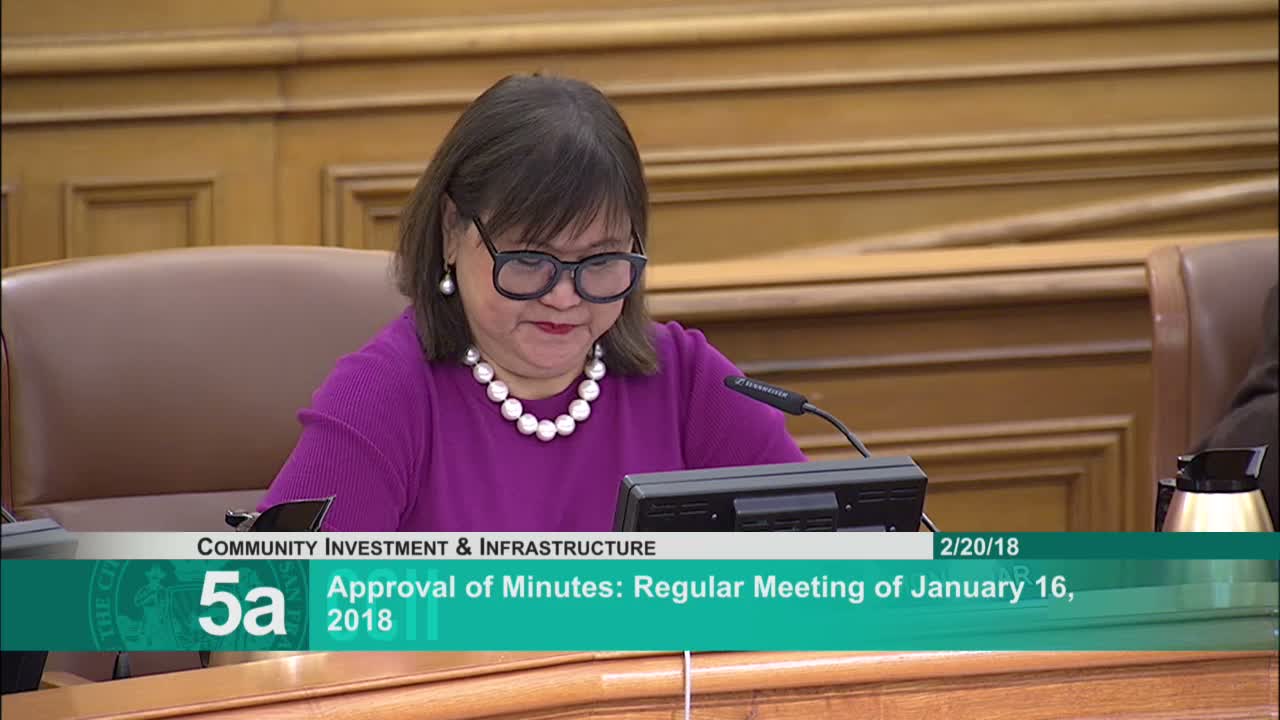
The Commission on Community Investment and Infrastructure voted Feb. 20 to approve two resolutions of intention that start the process to form Community Facilities District No. 9 for Hunters Point Shipyard Phase 2 and Candlestick Point and to authorize incurring bonded indebtedness not to exceed $6,000,000,000.
Deputy director of finance Grama Hoarder told the commission the proposed CFD — which would initially create Improvement Area 1 covering four parcels — would allow the successor agency to levy a facilities special tax and a services special tax to reimburse the developer for qualified infrastructure costs and to fund operations and maintenance in perpetuity. "Once we form the CFD, we will levy a special tax in the areas that are identified as being within the CFD boundary," Hoarder said during the presentation. She added the financing plan allows either PAYGO reimbursements to the developer or bonds secured by special taxes and property-tax increment.
The resolutions approved on their intent do not themselves levy any tax or issue bonds; they set boundaries, list authorized facilities and services, identify rate-and-method parameters and establish the $6 billion overall debt limit. Hoarder said the term of some special taxes could be as long as 75 years and that a residential facilities tax would not exceed 2 percent of the average estimated sales price under the RMA. She also described an escalator for the services tax tied to either the Consumer Price Index for the San Francisco–Oakland–San Jose region or 5 percent, whichever is lower.
Consultant Susan Goodwin of Goodwin Consulting, the city’s existing CFD administrator, told commissioners it is uncommon to form a CFD and never levy a tax, but she cited past examples — such as Mission Bay CFD No. 4 and certain years in Hunters Point Phase 1 — when offsetting tax increment or lack of maintained open space meant a services levy was not required. Hoarder said the CFD would initially tax private development parcels and not agency‑owned affordable housing or public parcels.
Commissioners sought detail on owners and disclosures. Commissioner Rosales asked who the property owners are; staff said the 5 Point master developer is the only affected owner for Improvement Area 1 at this stage. Rosales urged clear, multilingual disclosures for future property owners so buyers understand special-tax implications. Vice Chair Bustos asked how CFD funds for shoreline improvements would address sea‑level rise; staff described the CFD as a backstop that could fund adaptation measures beyond current development requirements.
The commission voted 4–0 to approve the resolutions of intention. Staff said subsequent administrative steps will follow, including an April 17 public hearing, property‑owner election and later proposed ordinances to order any levy of special taxes.