Get Full Government Meeting Transcripts, Videos, & Alerts Forever!
Get email alerts on the Public Art Mural topic
No spam. Unsubscribe anytime.
San Francisco school board authorizes CEQA review to remove Arnautoff mural from student view; amendment to add relocation fails
Summary
After more than three hours of public comment both for and against it, the San Francisco Board of Education voted to authorize staff to begin a CEQA review of options to remove the Victor Arnautoff mural at George Washington High School from student view; an amendment to explicitly add relocation or other permanent‑removal options failed on a 4–3 vote.
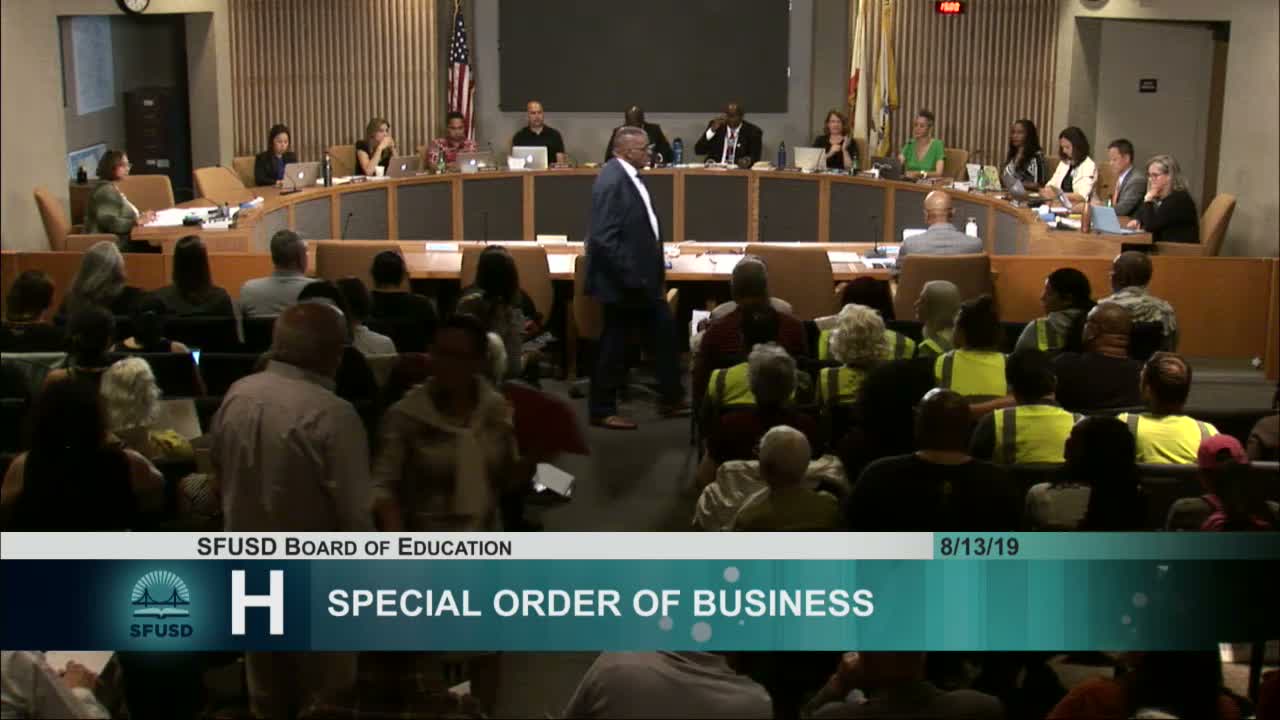
The San Francisco Board of Education on Aug. 13 authorized staff to develop a CEQA review of alternatives to remove the Victor Arnautoff mural at George Washington High School from student view, after an hours‑long public comment period that included alumni, artists and students.
The resolution, read into the record before public comment, directs staff to assess a range of alternatives for an environmental review that would remove the mural from public view using solid panels or reasonably similar material or methods. Commissioner Vallé Collins moved an amendment to explicitly add options — including permanent removal from student view and possible relocation offsite — but the amendment failed on a roll‑call vote (three yes, four no).
The decision followed a lengthy public comment period divided by the board into speakers urging preservation and speakers urging removal. Amos Brown, president of the San Francisco branch of the NAACP, urged the board to “leave that mural alone” and said he came “to be a truth teller.” Speakers who favored removal — including students, parents and indigenous elders — described the mural’s imagery as traumatizing and harmful to students and urged the board to honor prior student demands to remove it.
Board members framed the vote as a balance between obligations to student welfare and preservation of historic art. Commissioner Lam said she would “always put students, educators, families in my highest priorities” and supported the staff‑led CEQA review. Commissioner Collins said her amendment sought to make clear the board could evaluate multiple options beyond paneling; legal counsel and the district’s facilities staff advised that CEQA scoping requires analysis of multiple alternatives, including a no‑project baseline.
The amendment vote was recorded as: Collins (yes); Lam (no); Lopez (yes); Maliga (no); Norton (no); Sanchez (yes); Cook (no). After the amendment failed, the board voted on the original resolution and approved it by voice and roll call; the clerk recorded four ayes and three noes. The board instructed staff to proceed with CEQA scoping so the full range of legally required alternatives can be analyzed.
Legal and procedural concerns were raised repeatedly during public comment. Several speakers urged the district to follow CEQA and the Brown Act and warned that failing to conduct a thorough, public review could prompt costly litigation. Staff told the board that CEQA requires evaluating a set of alternatives, including a no‑project option, and that the scoping process would set the final list of alternatives to be analyzed.
The board did not set a timetable during the meeting for completing the CEQA scoping or drafting an environmental impact report; staff said scoping and the full evaluation would follow once the board’s preliminary guidance was recorded. The decision supersedes the board’s June 2019 action on the mural and initiates a formal environmental review track. The board closed the item and moved on to the rest of its agenda.
What’s next: staff will begin CEQA scoping to determine the set of alternatives and an environmental analysis; public input is expected to be part of the CEQA process. No final physical action (installation of panels, relocation or painting over) occurred at the meeting — the vote authorizes the study and development of options.
— Quote highlights: “I just came tonight to be a truth teller,” Amos Brown; “The function … of racism is distraction,” Commissioner Collins.